The best job boards for tech and startup roles in 2026
 Adam Sabla
Contents
- Researched
- 2026
- Scope
- US and English-speaking, tech-leaning
- Screenshots
- captured 2026
Start here
Job boards are not interchangeable, and the biggest ones finish last
Here is the reason to be picky. In the only large public dataset on this question, 598,627 applications tracked through 2025, the three boards most lists put at the top finished at the bottom. Indeed came seventh of nine, LinkedIn eighth, ZipRecruiter ninth. The full table is below, caveats included. Part of the explanation is that those boards are fewer companies than they look: Recruit Holdings owns Indeed, Glassdoor and SimplyHired, so running all three is closer to one search repeated than to three searches.[1][2]
The part most lists leave out is what happens after you pick a better board. Applying became effectively free for everyone at the same time, and the volume followed. Greenhouse, one of the largest applicant tracking systems, put its own platform at 175,000 live jobs averaging 254 applicants each, though Fortune states no time window, so read that as a pile size rather than a rate. A better portal changes how early and how directly you reach an employer. It does not change the fact that a person then has to pick your application out of the pile.[3]
So this page does two things. It tells you which portals earn your time in 2026, one by one with a screenshot of each, and which to skip and why we think so. And it is honest that choosing the right board is the smaller of the two levers you control. The larger one is what you send.
One more thing before the list. Five of the boards on the roundups you read this morning are dead. Hired.com redirects to a corporate page that does not contain the word Hired. Pangian's domain now points at a hosting placeholder. Women Who Code shut down in 2024 and is still recommended in the present tense. Jump to the skip list
The evidence
What 598,627 applications actually showed
One dataset is worth knowing before the list. Huntr, which sells a job search product, tracked 598,627 applications from more than 57,000 job seekers through 2025 and published the response rate by source. Read the ordering rather than the levels: these users self-selected into a job-tracking tool, so they are unusually organized.[1]
Two things to be straight about. This is 2025 data: Glassdoor's integration into Indeed completed in 2026 and Otta folded into Welcome to the Jungle in 2025, so at least two rows describe a surface that has since changed. And the dataset covers nine sources, seven of which appear on this page. The other twenty-four entries below are our judgment, made against the same three tests we applied to everything: does the page load and carry real inventory, does it tell you the price, and does it get you closer to the employer's own form.
| # | Source | Response rate | |
|---|---|---|---|
| 1 | Google Jobs | 11.29% | |
| 2 | GovernmentJobs.com | 8.67% | |
| 3 | Wellfound | 5.95% | |
| 4 | Glassdoor | 5.46% | |
| 5 | Handshake | 5.06% | |
| 6 | Welcome to the Jungle | 4.52% | |
| 7 | Indeed | 4.46% | |
| 8 | 3.10% | ||
| 9 | ZipRecruiter | 2.82% |
The two biggest generalists finished seventh and eighth of nine, which is worth noticing before you spend another evening on them.
Read the table again and the pattern is not board size. Glassdoor beat Indeed while carrying much the same inventory, which means this is not measuring which jobs a site holds. What varies is how the application arrives at the other end, and how many others arrive the same way.
If you have twenty minutes tonight
The short version, in order
- Run the applicant tracking system search below. It is free, it takes a minute, and it puts you on the employer's own form.
- Open HiringCafe and filter to posted in the last 48 hours plus your salary floor. Check the country filter first, it geolocates.
- Check Levels.fyi for your level's band before you name a number anywhere.
- When the same role is reachable two ways, apply on the employer's own site rather than through a board.
- Use LinkedIn to be found, not to apply. Indeed, LinkedIn and ZipRecruiter finished seventh, eighth and ninth of nine on response rate.
The reasons for all of it are below, portal by portal.
The portals below are numbered 1 to 31 in our order of usefulness to this reader. Where the response-rate data covers a portal it drove the position; for the other twenty-four it is our judgment against the three tests above. The groups still matter more than the number: 24 is not worse than 9 if 24 is the one that fits you.
Search tools that reach the employer directly
Search tools that index employers' own career pages and hand you the employer's own application form. This is the smallest group on the page and the one we would start with.
Costs nothing
The free search that does most of the work
Most venture-backed employers post through one of three applicant tracking systems, and search engines index all three. Paste these into Google with your own role and city.
site:job-boards.greenhouse.io "product manager" Chicagosite:jobs.lever.co "product manager" Chicagosite:jobs.ashbyhq.com "product manager" ChicagoAshby publishes no directory of its own, so the search engine is the index.
HiringCafe
- free
- search over ATS
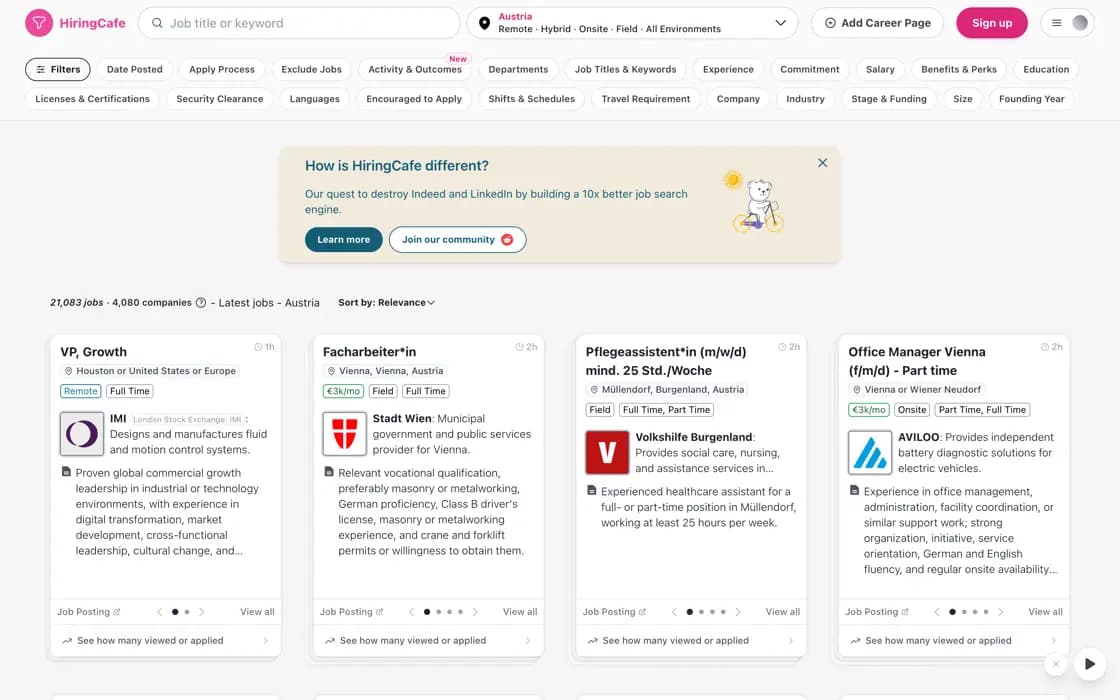
A free search engine that crawls company career pages and applicant tracking systems directly, then uses a language model to normalize every posting into one deeply filterable index.
Best for
Running a narrow search: posted in the last 48 hours, funding stage, salary floor, security clearance, no cover letter required.
Watch out
Coverage is incomplete and it does not tell you what it is missing. The site geolocates server-side, so it may open on the wrong country and quietly stay there.
MyGreenhouse
- free
- ATS-native
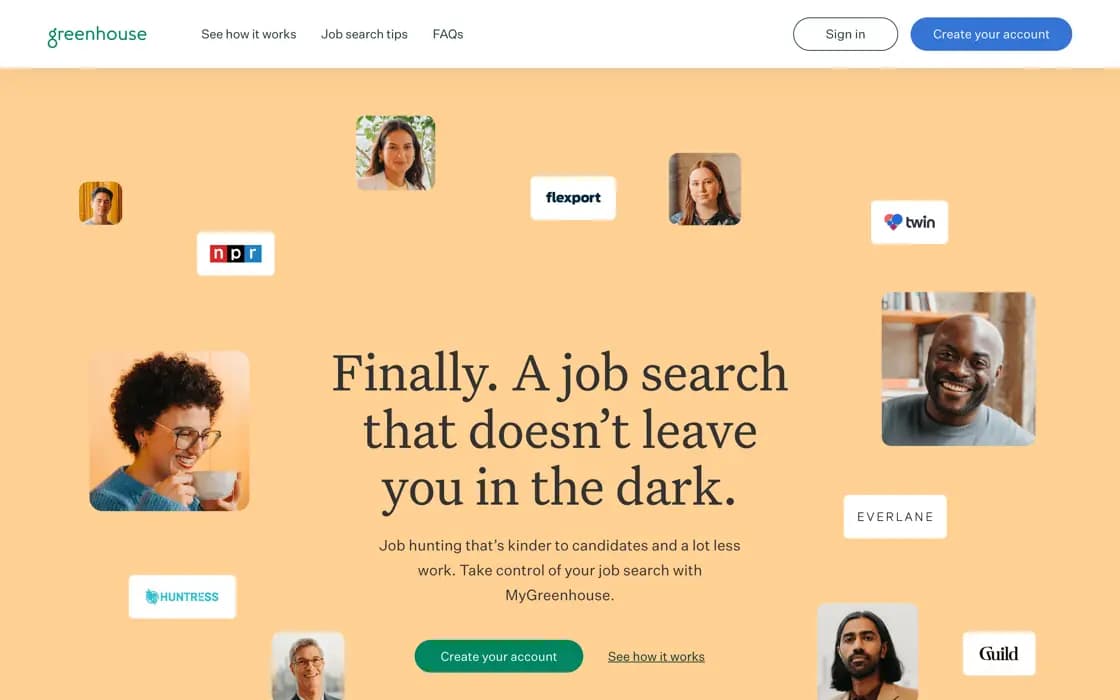
Greenhouse's own candidate-side product: one profile that autofills applications across every company using Greenhouse, plus a search across their live postings.
Best for
Anyone applying to venture-backed companies, where Greenhouse is close to the default. You are inside the system the recruiter reads from rather than feeding it from outside.
Watch out
Only covers Greenhouse customers, and it walls you at a sign-in before you can see anything. Greenhouse's own data is also the source of the 18 to 22 percent ghost-job figure, measured on its platform in 2024 and not refreshed since, so its index is not clean either.
Evidence
Greenhouse's chief executive put the platform at 175,000 live jobs in 2026.
Simplify
- freemium, price not published
- autofill + tracker
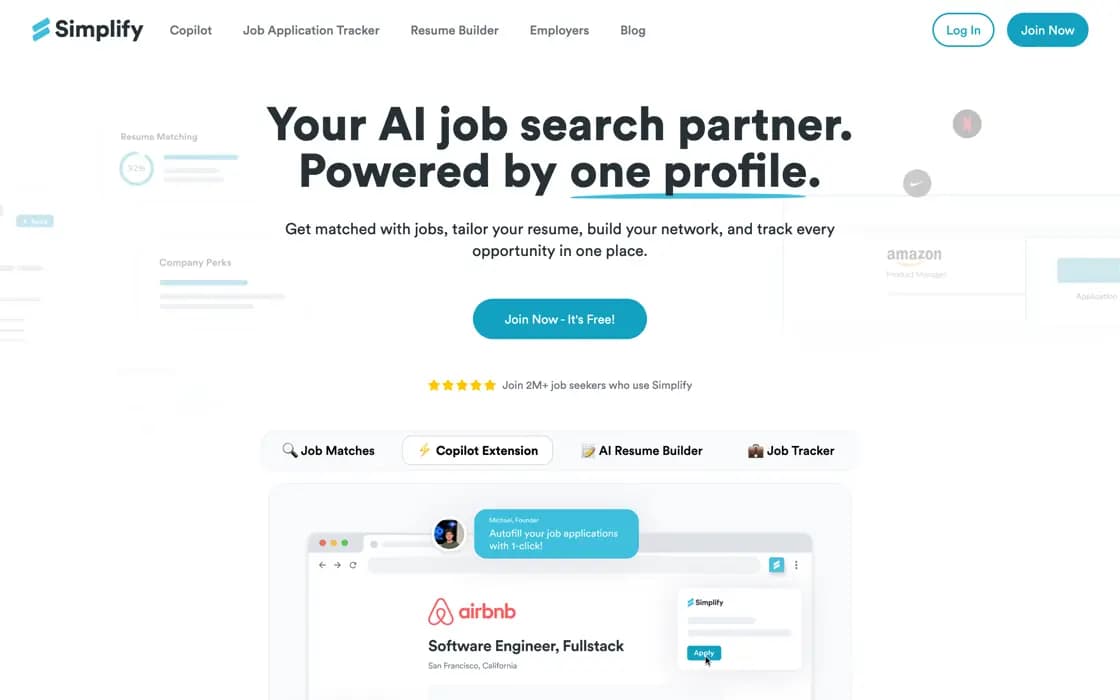
A browser extension that autofills applications on Greenhouse, Lever, Workday and similar, with a job board and tracker attached.
Best for
Cutting the mechanical cost of applying on company sites, which is the friction that pushes people back to one-click apply.
Watch out
It does not publish a price. simplify.jobs/pricing returned a 404 when we checked. Autofill is the useful half; treat the matching scores as decoration.
Startup and tech boards worth your time
Curated, portfolio and community surfaces. Volume is low and signal is high, and most are free. Be clear-eyed that several are aggregators with a curator's name on them rather than primary sources, and we say which. One pattern to name rather than recommend: some boards in this category manufacture urgency by delaying free-tier listings behind a paid head start. We cut one entry from this list for exactly that reason.
Hacker News: Ask HN: Who is hiring?
- free
- community thread
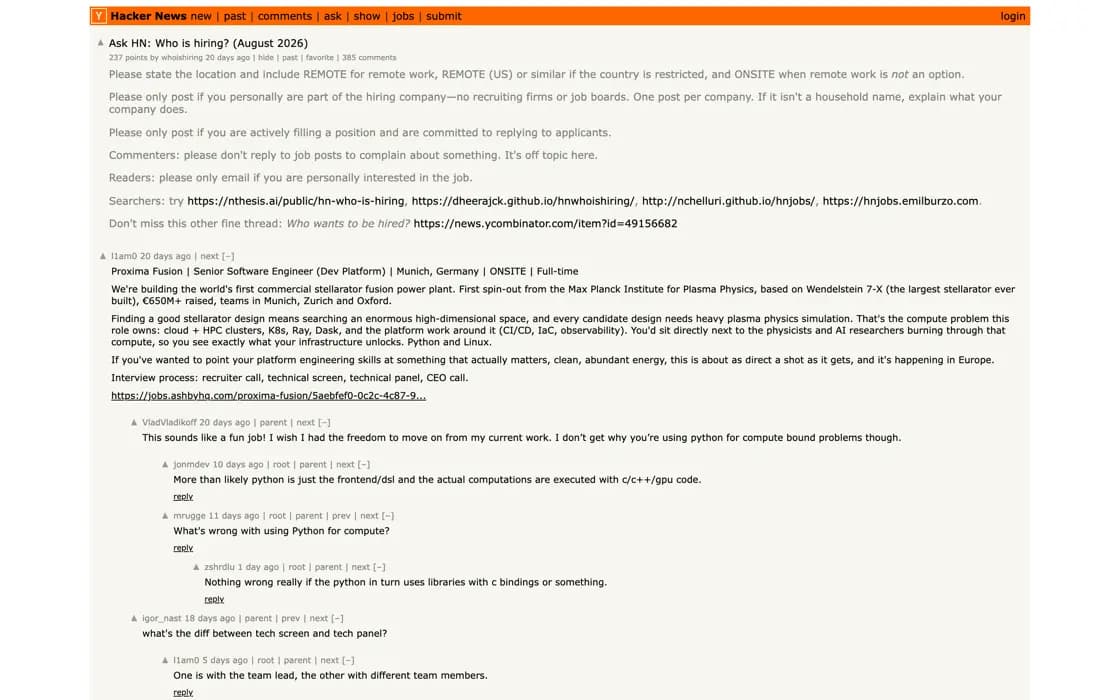
A single monthly thread, posted on the first working day of the month, where companies post one comment each and a named engineer usually replies to you.
Best for
Reaching a human at a technical company with no recruiter in between. The rule that one company posts once keeps the signal high.
Watch out
No filtering worth the name, so you read it with the browser's find function or one of the community search wrappers. Skewed to startups and to engineering.
Evidence
The current thread carried 385 comments when we checked. Comment counts include replies, so that is not a count of open roles.
Wellfound
- free for seekers
- startup board
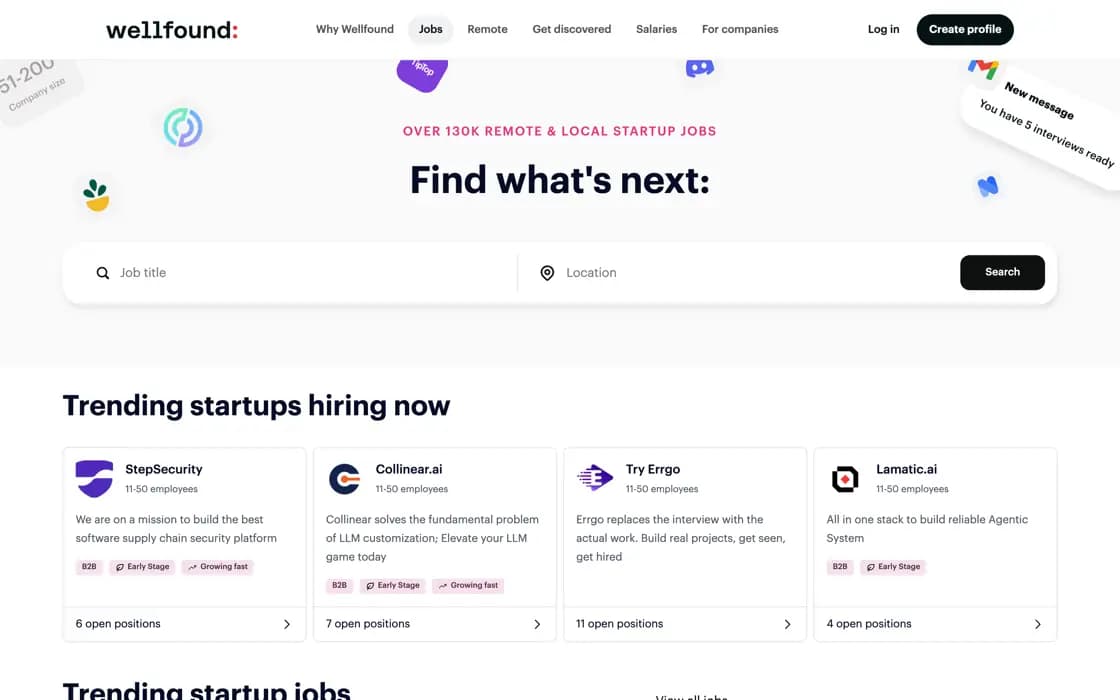
The startup job board formerly known as AngelList Talent, with salary and equity ranges shown up front on most listings.
Best for
Startup roles where you want compensation visible before you invest time. It placed third of nine on response rate, roughly double LinkedIn.
Watch out
Its reputation peaked some years ago and the experience has thinned since. We nearly wrote it down until we checked it against the response-rate data, which disagreed with us.
Y Combinator: Work at a Startup
- free
- portfolio board
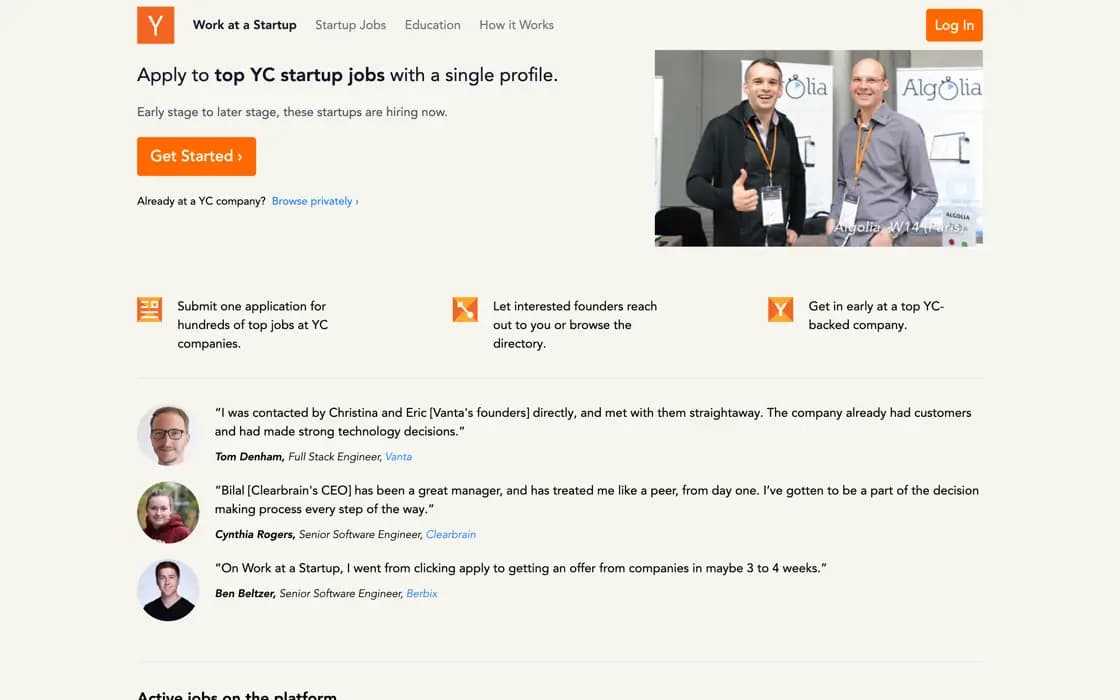
One profile, then direct messaging with founders across the YC portfolio.
Best for
Early-stage appetite. You are often talking to a founder, not a recruiter, and the loop is short.
Watch out
YC companies only, heavily weighted to very early stage, and equity-heavy compensation. Requires an account before you see much.
TrueUp
- free
- tech aggregator
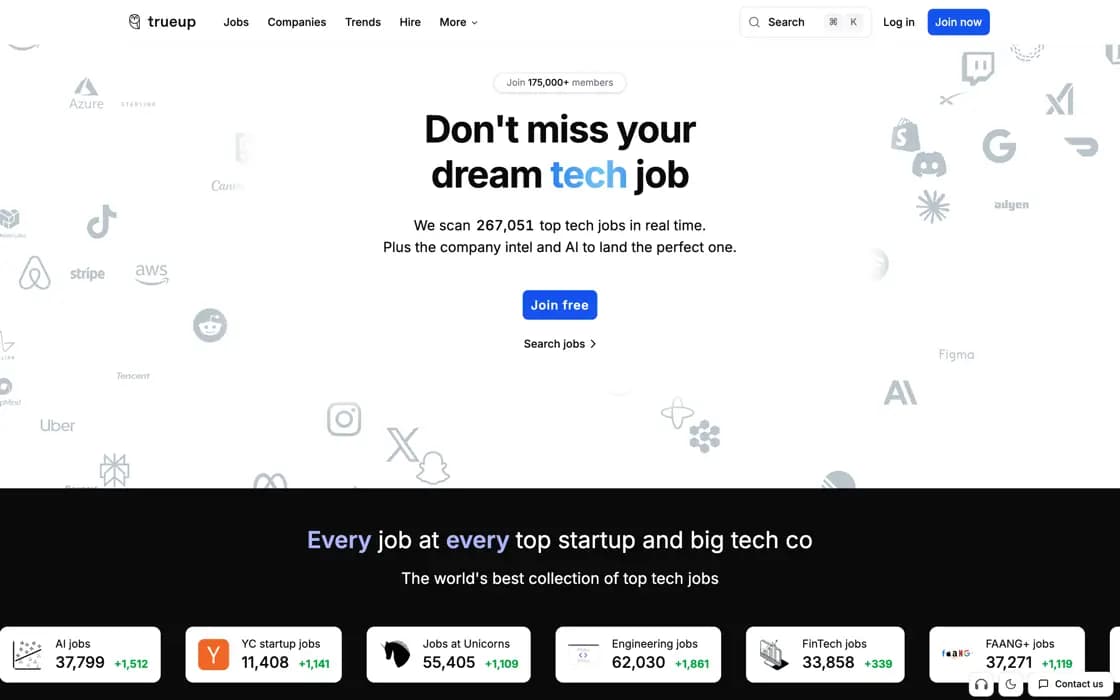
A real-time aggregator of tech jobs with company intel and rankings layered on top, covering funded startups through big tech.
Best for
Seeing the whole tech market in one place, and for its company lists when you are building a target list rather than applying today.
Watch out
It is an aggregator, so ghost jobs and duplicate requisitions pass straight through. Its headline counts are self-reported.
Lenny's Jobs
- free, one paid-subscriber feature
- curated
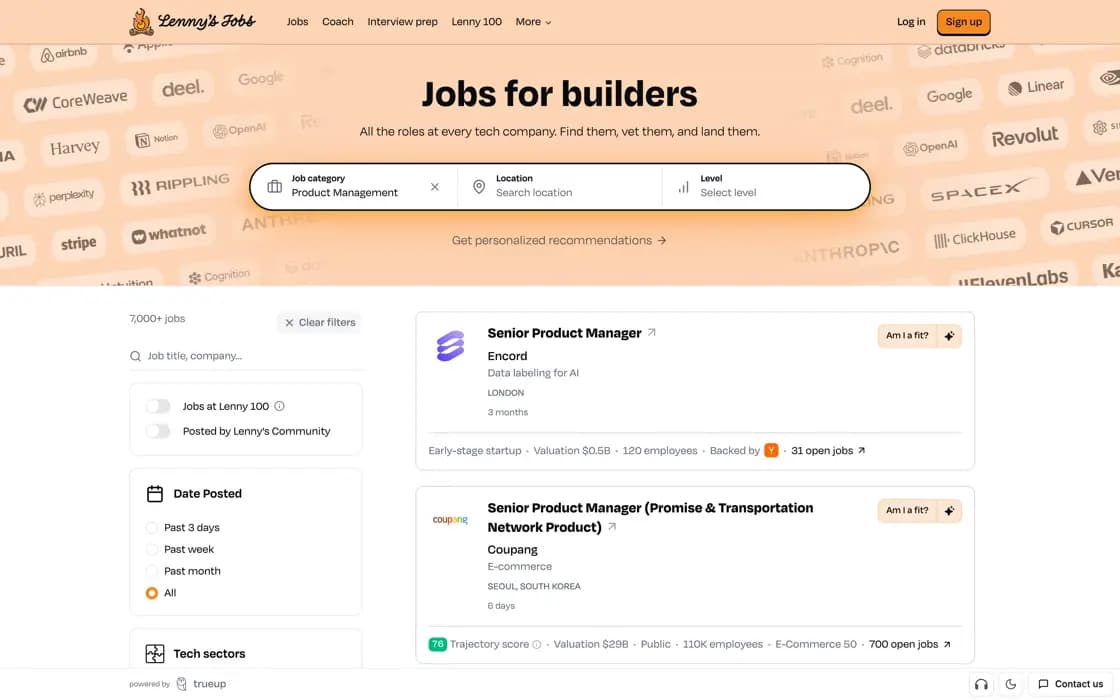
A board scoped to product, engineering, design and growth roles at tech companies, built by Lenny Rachitsky with TrueUp.
Best for
Product and growth people specifically, where the curation is genuinely narrower than a general board.
Watch out
It runs on TrueUp's index, so it inherits TrueUp's data rather than sourcing its own. Its per-role AI features are thin next to the board itself.
a16z speedrun talent network
- free, no candidate pricing stated
- portfolio board
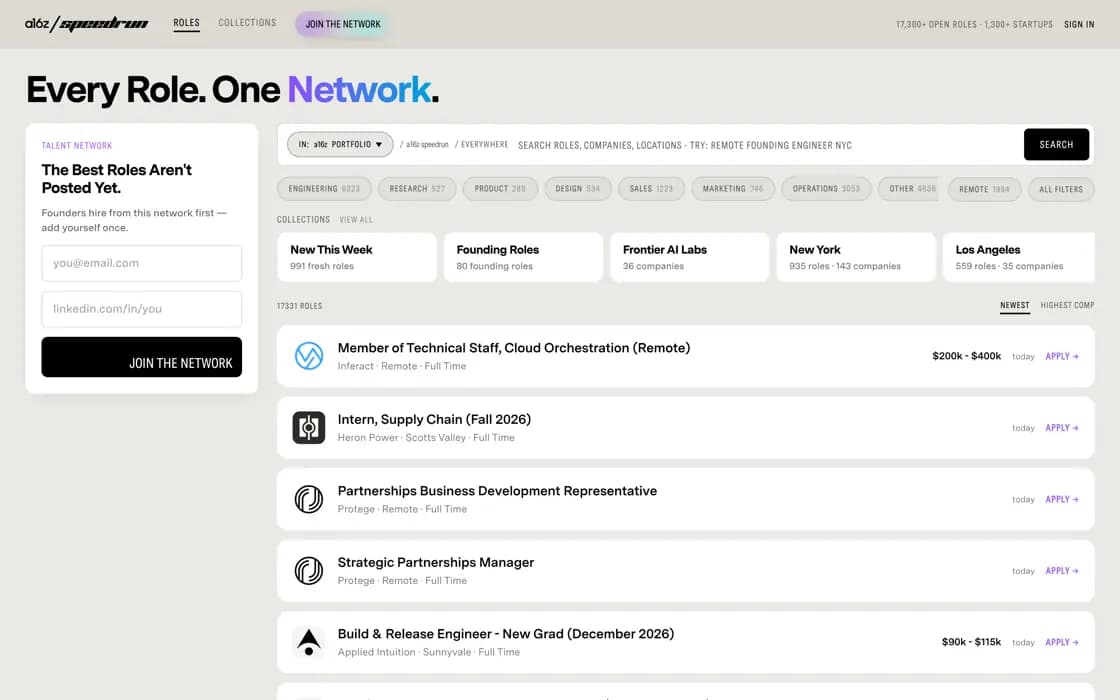
A talent network for companies funded through a16z's speedrun program.
Best for
Early-stage roles at a specific, well-capitalized portfolio, which is a different pool from the general startup market.
Watch out
Narrow by design and small. Worth twenty minutes, not a weekly habit.
Getro
- free to browse
- portfolio network
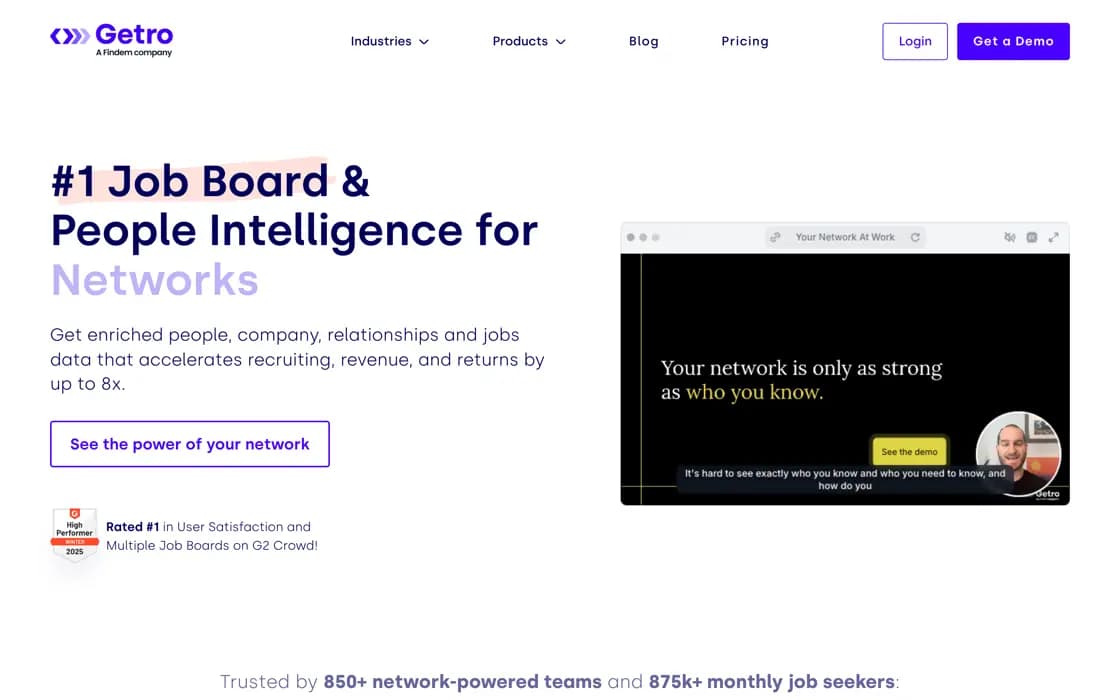
The company that powers a large share of venture portfolio job boards, and a directory of the networks it runs.
Best for
Finding portfolio boards you did not know existed, which is its real use. The individual boards are the destination, not this page.
Watch out
Its own product is sold to investors and communities, not to you, so the front door is business-to-business. It also ingests from LinkedIn and Indeed, so it is not a primary source.
A better portal gets your application in front of someone earlier. It does not decide what happens when they open it. That second half is what we work on, and the argument for why it matters is at the end of this page.
Remote-only boards, ranked honestly
Remote supply in software has not recovered to its 2022 peak, and the remote-board category has monetised harder than any other on this page. Three of the best-known names in it are in our avoid list below rather than here, which tells you most of what you need to know about the category.
Himalayas
- free
- remote board
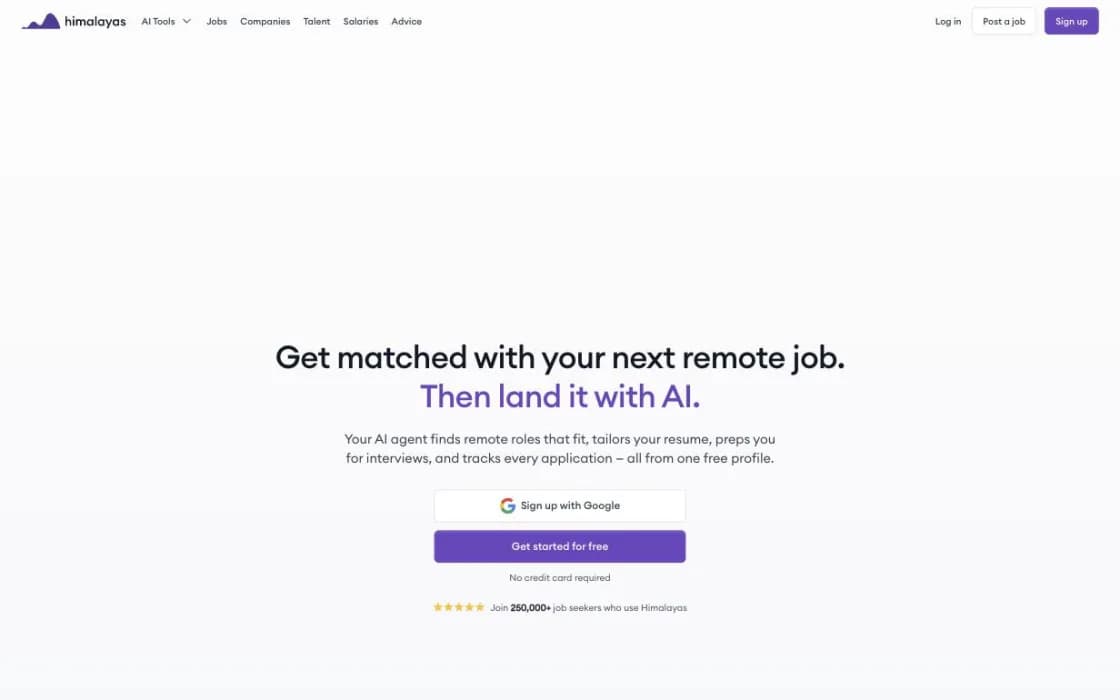
A remote job board with profile-based matching, an application tracker and a public MCP server so an AI assistant can query its index directly.
Best for
Remote roles with genuinely free tooling around them, and for anyone who wants their assistant to search job listings rather than doing it by hand.
Watch out
Its 100,000-plus live jobs figure is self-reported. Also worth saying plainly: Himalayas ships a free AI resume builder, which competes directly with what we sell. We are recommending it anyway, because on remote coverage it earns the place.
We Work Remotely
- free to browse and apply
- remote board
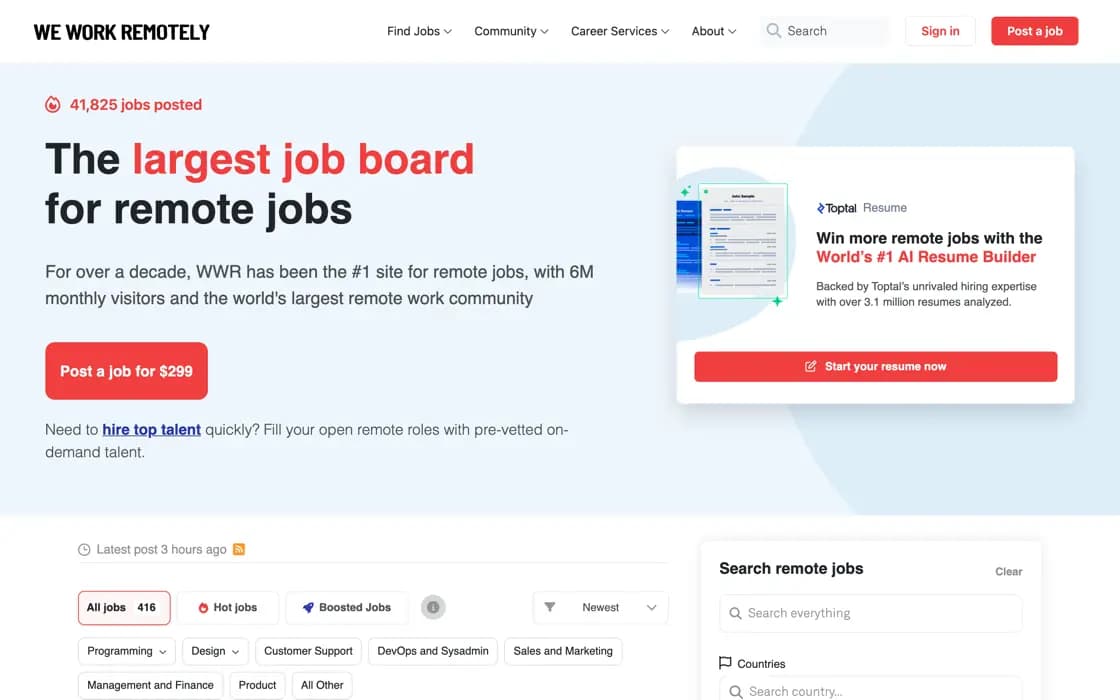
One of the longest-running remote boards, still largely a straightforward list of paid employer postings.
Best for
Browsing without an account and without being funnelled into a subscription. Employers pay to post, which filters out some noise.
Watch out
Its own upsells to job seekers are where the value drops off sharply. Browse it, ignore the paid tiers.
Working Nomads
- freemium
- remote board
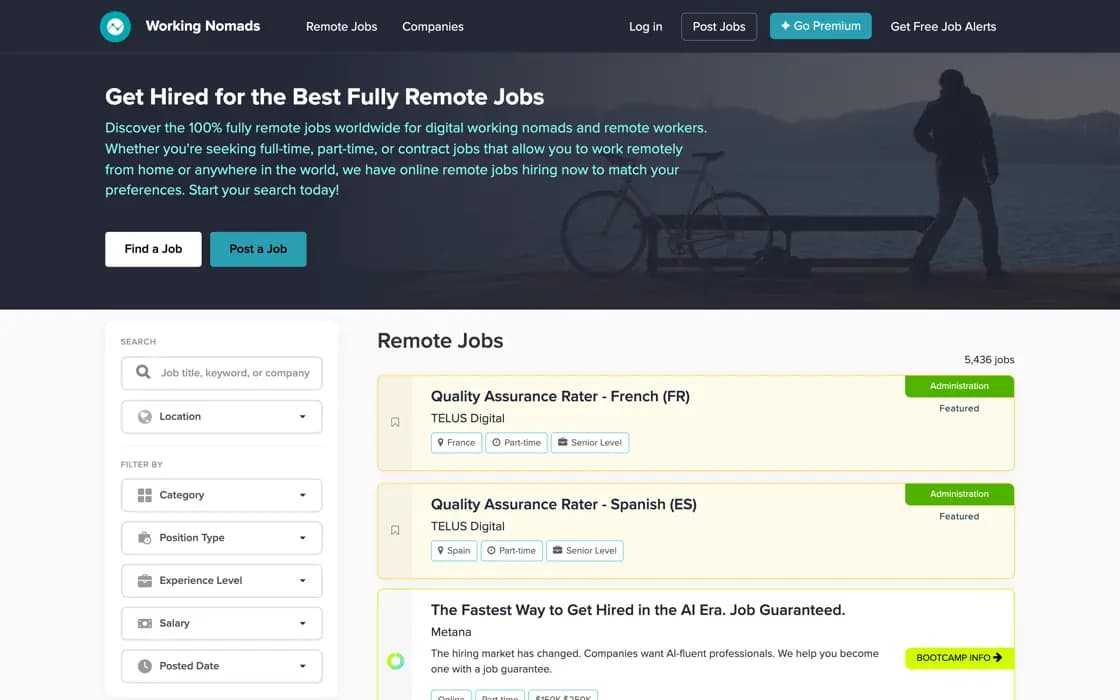
A curated remote listing feed organized by category, with an email digest as the main product.
Best for
Passive monitoring by email rather than active searching.
Watch out
Much of the inventory is aggregated from elsewhere, so expect overlap with boards you already read.
Dynamite Jobs
- free
- remote board
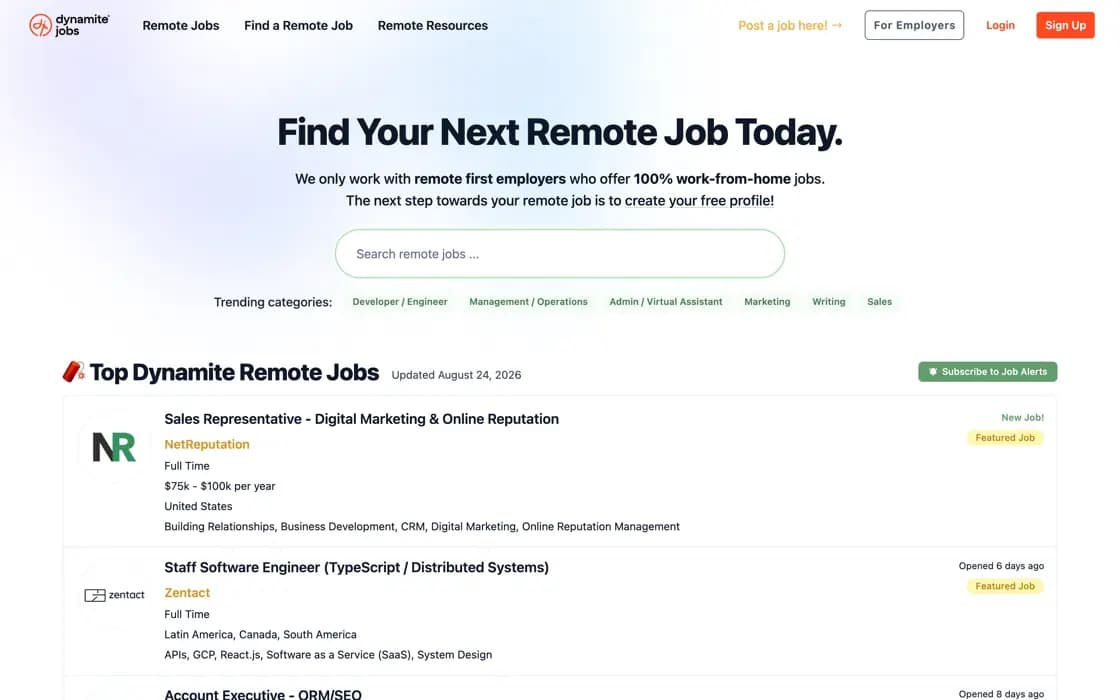
A remote board focused on small and mid-sized fully remote companies, many of them bootstrapped rather than venture-funded.
Best for
Finding employers that are remote by construction rather than remote by concession, which is a meaningfully different set from the big boards.
Watch out
Small volume, and salaries skew below venture-funded benchmarks.
Boards worth reading, not applying through
These are worth opening, several are indispensable for research, and none of them is where we would press submit if the same role is reachable another way. Indeed and LinkedIn finished seventh and eighth of nine in the response-rate table.
Google for Jobs
- free
- search feature
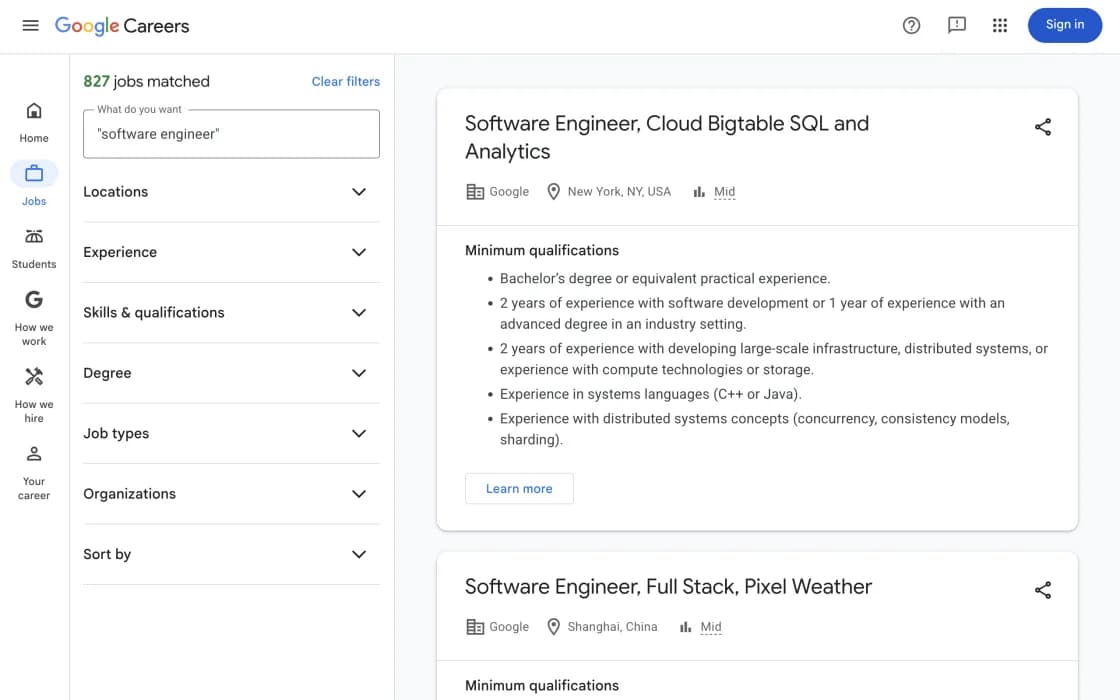
Not a board. A search feature that ingests structured job data from employer sites and boards, shows it in a filterable widget, and sends you to the original posting.
Best for
Finding the employer's own posting for a role you already know about. It ranked first on response rate in the 2025 dataset.
Watch out
It surfaces what publishers mark up correctly, which is not the whole market. Whether the widget still appears reliably now that AI Mode is the default Search experience is not something anyone has measured publicly.
Levels.fyi
- free to browse
- compensation intel
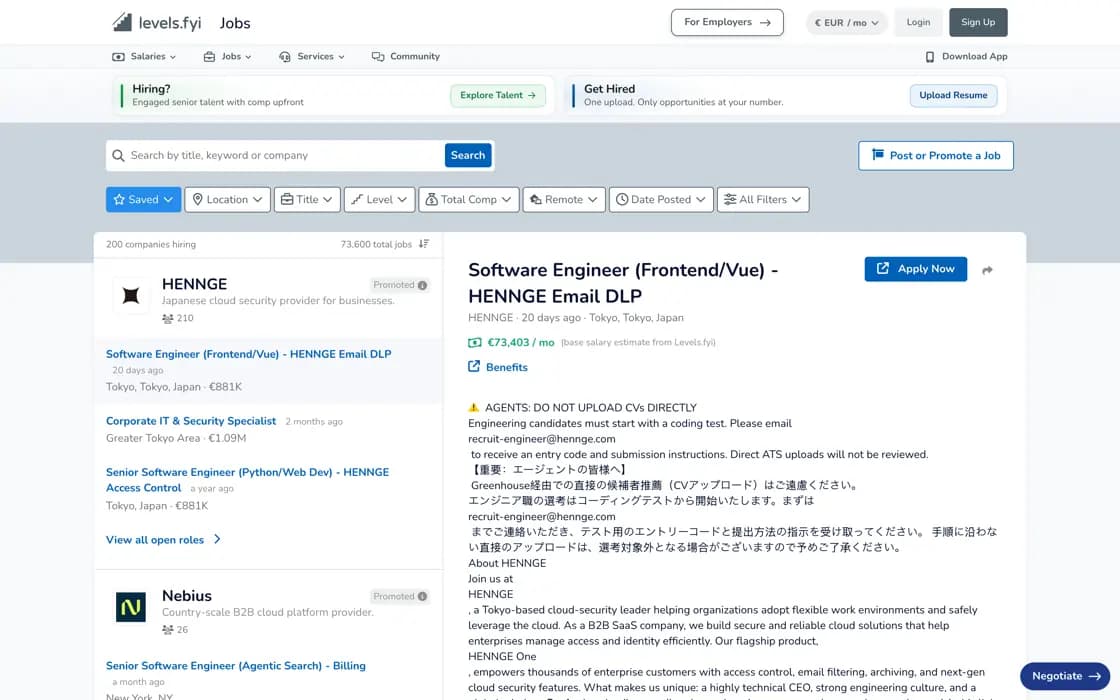
Crowdsourced compensation data mapped to internal levels, with a job board attached.
Best for
Knowing what a level is worth before you name a number, and translating titles between companies. This is the single best-value half hour on this page.
Watch out
Self-reported data skews senior and skews to large tech employers. The board is secondary to the data.
LinkedIn Jobs
- freemium
- generalist
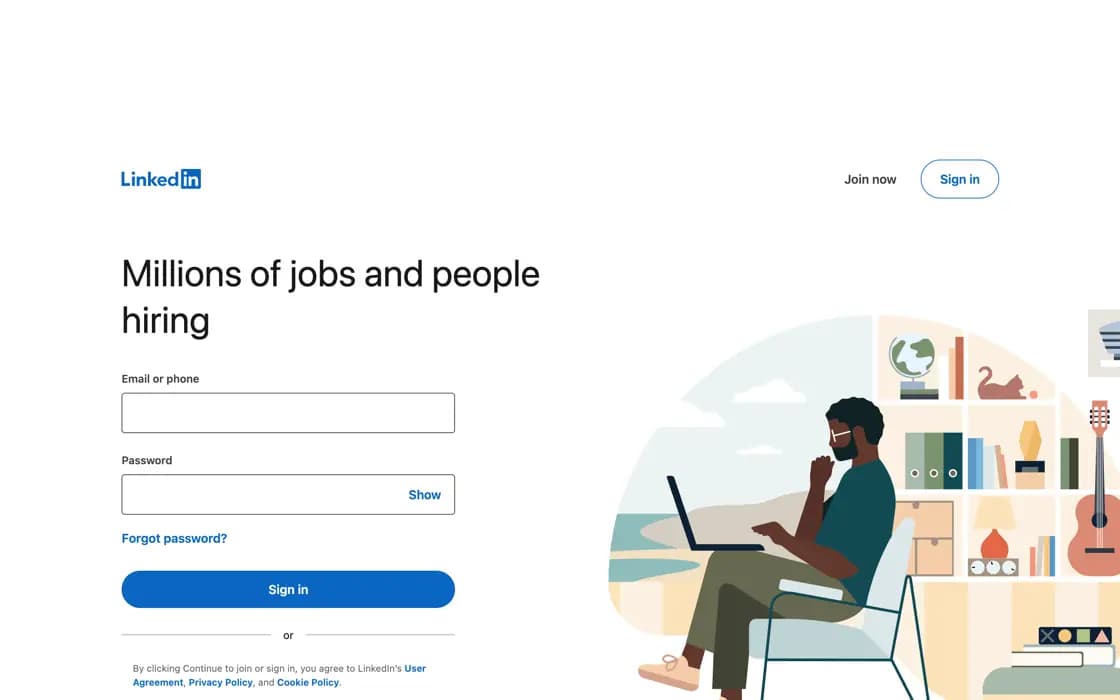
The largest professional network, and the place the recruiter will look you up regardless of where you applied.
Best for
Being found, researching people, and warm intros. Your profile matters here even when the job posting does not.
Watch out
Eighth of nine on response rate at 3.10 percent. One-click apply is the mechanism that produces the applicant volumes everyone complains about.
Blind
- free
- community
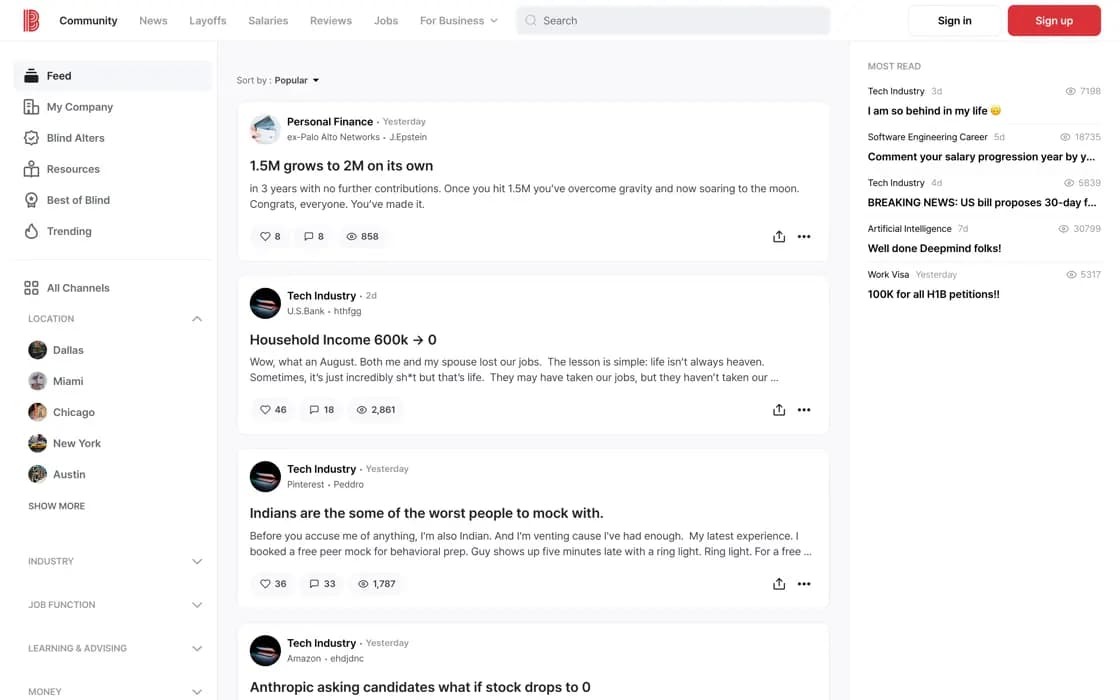
A work-email-verified anonymous community for tech employees, with a jobs surface attached.
Best for
Finding out what working somewhere is actually like, and what an offer is really worth, from people currently inside.
Watch out
Anonymity plus compensation talk produces a bleak and status-obsessed register. Useful for facts, corrosive as a daily habit.
Built In
- free
- city tech boards
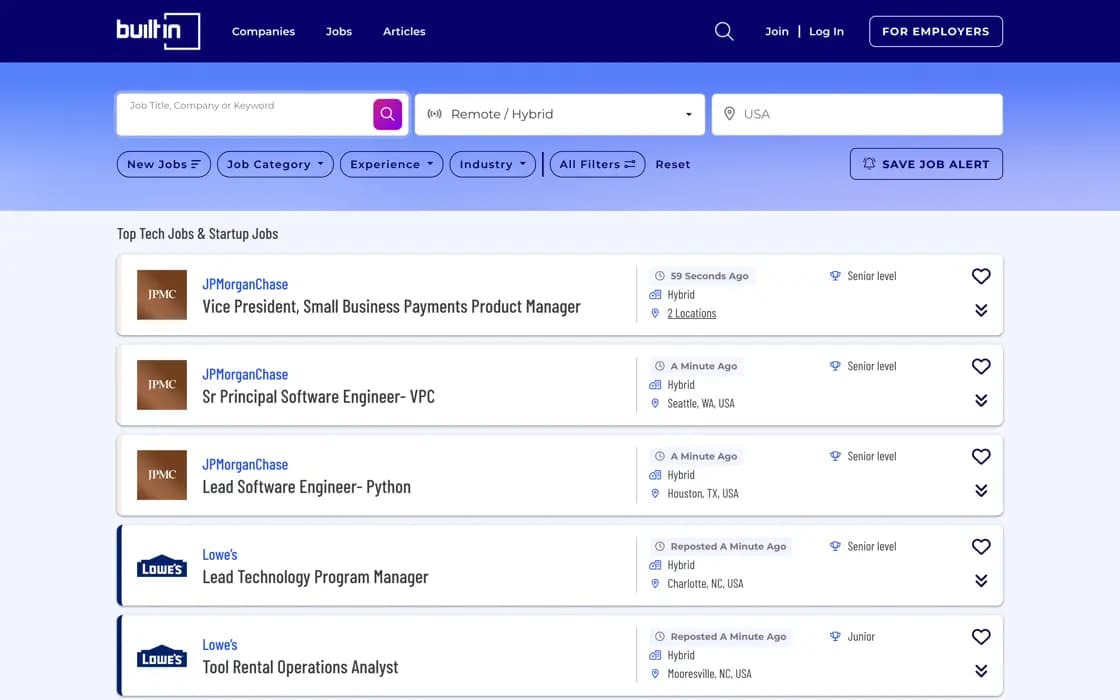
City-scoped tech job boards with company profiles, covering most major US tech hubs.
Best for
Location-anchored searching, and for the tech-adjacent non-engineer, where it is one of the few decent options on this page.
Watch out
Employers pay for profiles, so presence signals marketing budget rather than quality. Coverage thins fast outside the main hubs.
Glassdoor
- free
- generalist + reviews
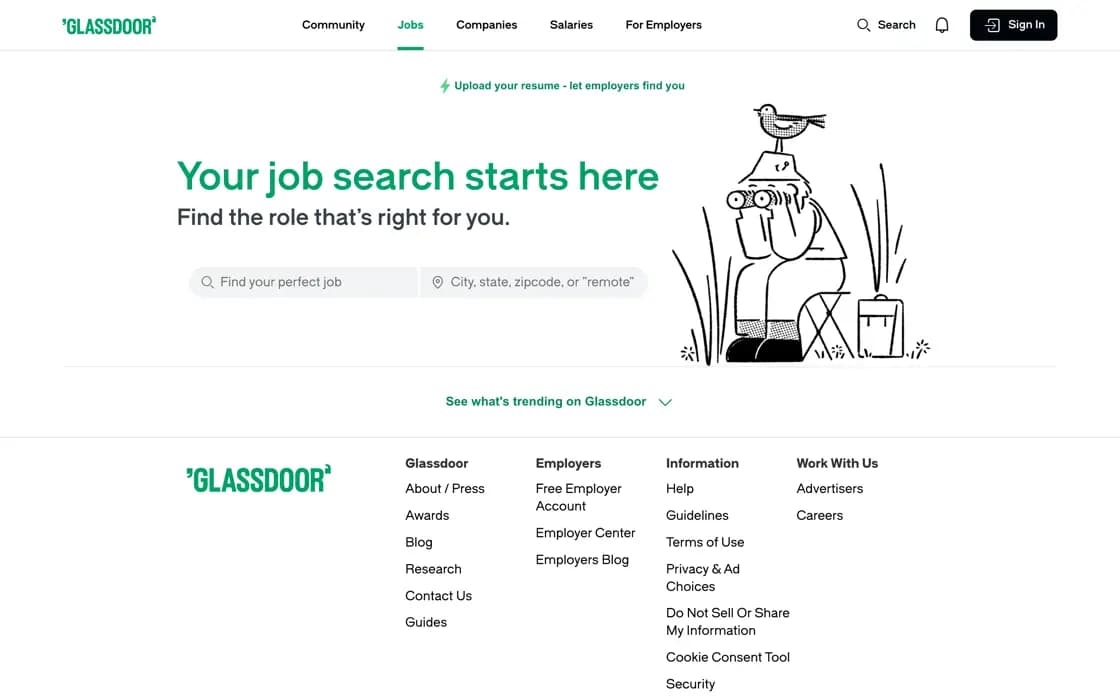
Employer reviews and salary data, now folded into Indeed, with substantially Indeed's job inventory attached.
Best for
Reading about an employer before an interview. The reviews remain the reason to visit.
Watch out
Reviews skew to the recently disappointed. Its integration into Indeed completed in 2026, so treat it as one surface with Indeed, not a second opinion.
Indeed
- free
- generalist
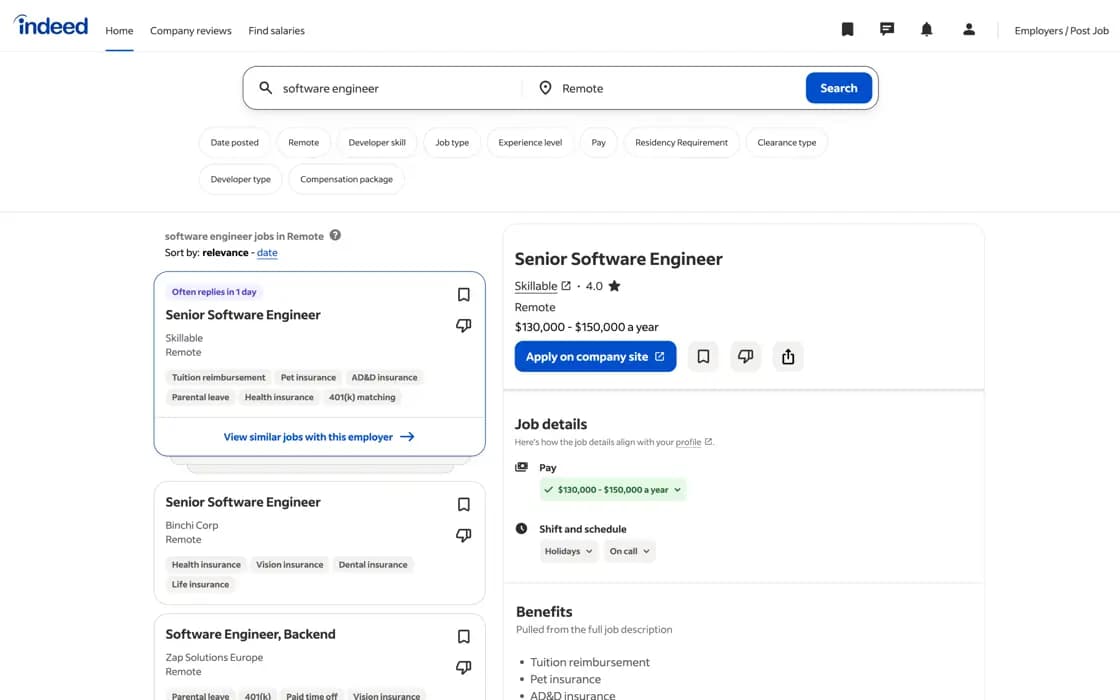
The largest job index in the US, now also the clearest example of visibility being sold rather than earned.
Best for
Breadth when you genuinely need it, and for checking whether a role exists at all.
Watch out
Seventh of nine on response rate. Sponsored placement increasingly determines what you see, and the same index reappears on Glassdoor and SimplyHired.
Niche boards for specific fields
Narrow boards that beat every generalist inside their niche and waste your time outside it. Read the one that matches you and skip the rest.
GovernmentJobs.com (NEOGOV)
- free
- public sector
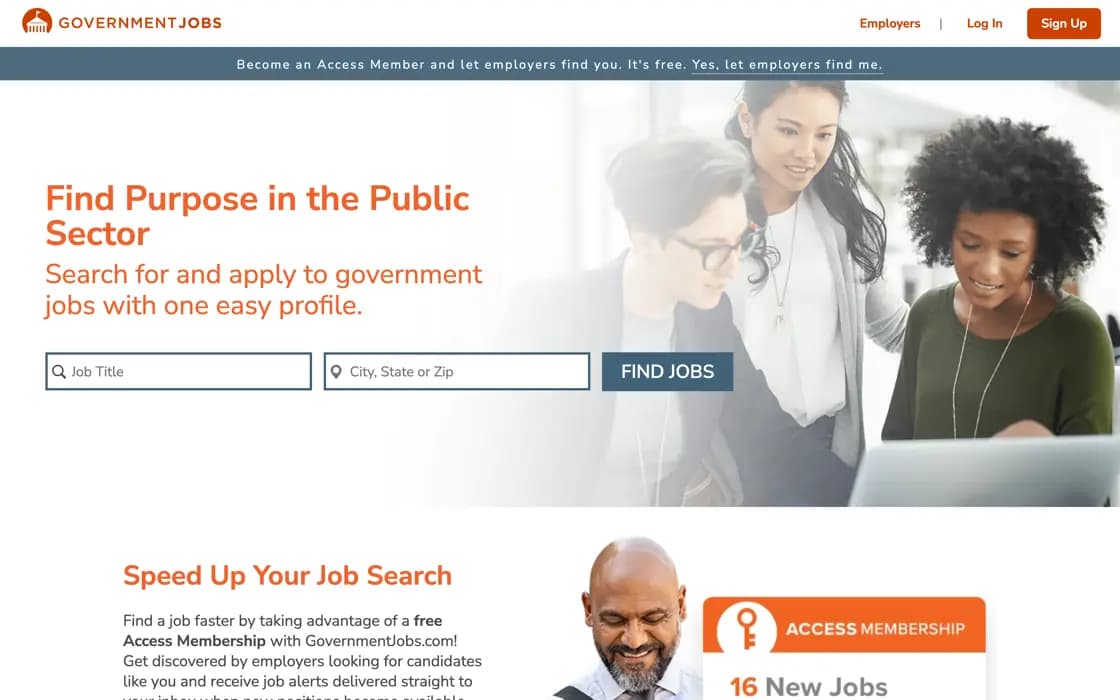
The mandatory application portal for most US state, county, municipal, public university, transit and utility employers, the way USAJOBS is for federal roles.
Best for
Data, analytics, IT security, GIS and program roles outside the federal government. It placed second of nine on response rate at 8.67 percent, ahead of every private board measured.
Watch out
Pay bands sit below private tech and hiring cycles are slow. Listings render client-side, so we could not independently count inventory.
USAJOBS
- free
- public sector
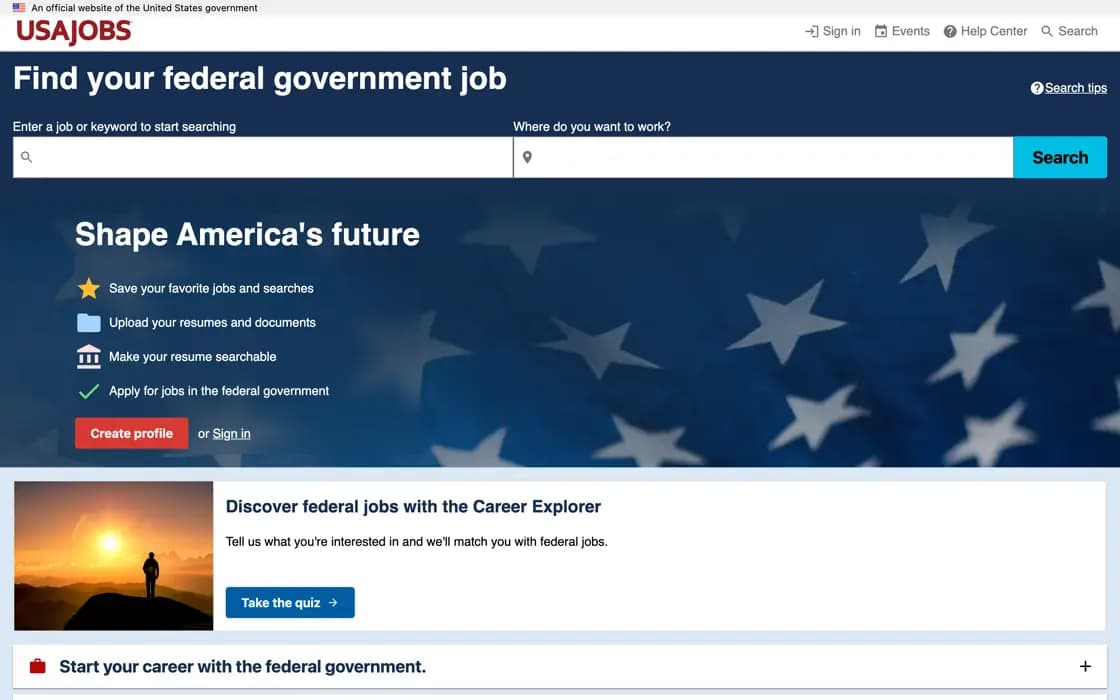
The single federal government job portal.
Best for
Federal roles, which have their own resume format and their own rules. Nothing else lists them.
Watch out
Federal hiring contracted sharply through 2025 and 2026. The federal resume is a genuinely different document, much longer than a private-sector one.
Dice
- free for seekers
- tech generalist
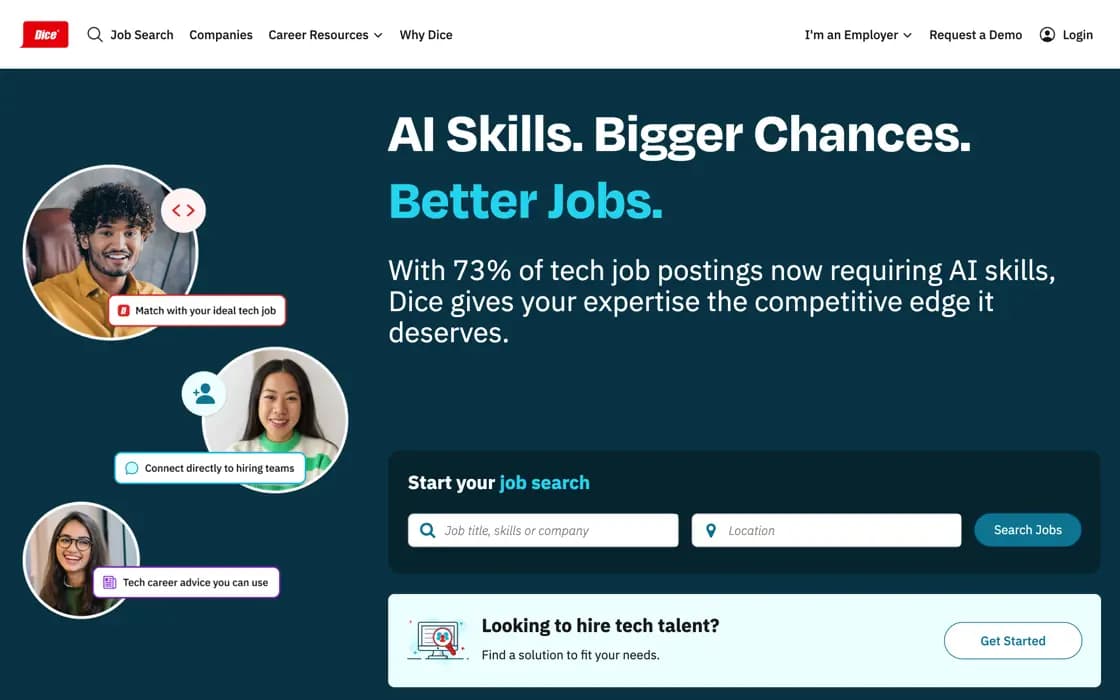
A long-running US technology job board, now with a public MCP server that lets an AI assistant query its index directly.
Best for
Contract and defence-adjacent technology work, and for agent-driven searching, where it was first to ship a real interface in 2026.
Watch out
Heavily staffing-agency weighted, so expect recruiter volume rather than direct employers.
ClearanceJobs
- free for seekers
- cleared roles
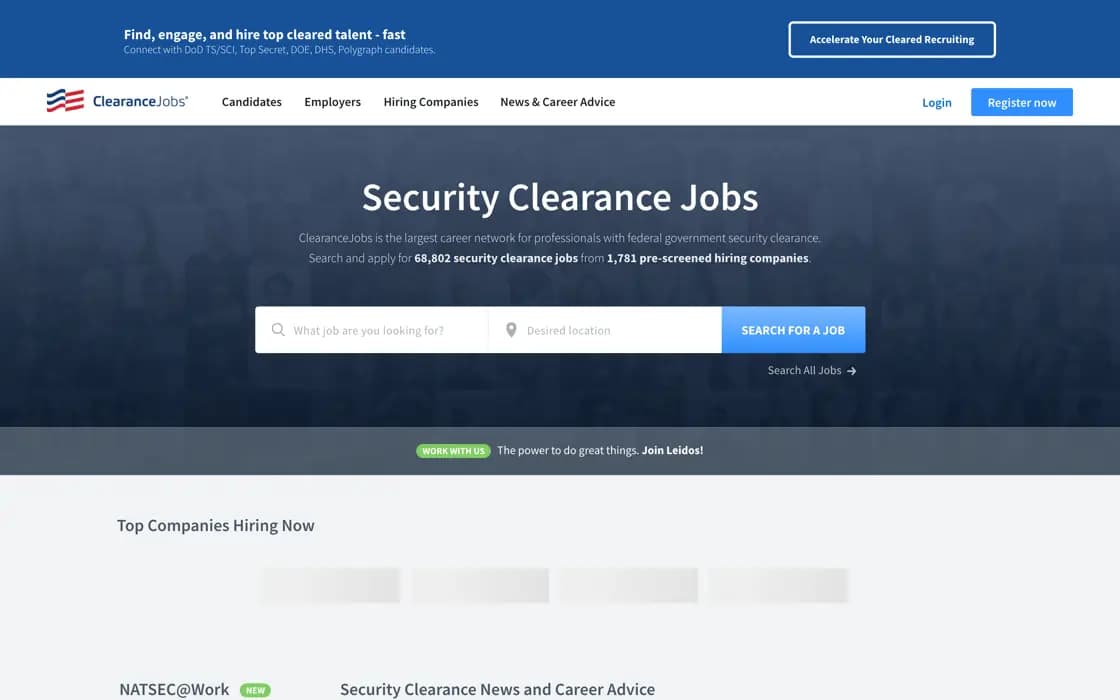
The dominant board for US roles requiring an active security clearance.
Best for
Anyone holding a clearance. The clearance is the filter, and it is a strong one.
Watch out
Useless without a clearance, and the employer set is concentrated in defence contracting.
Welcome to the Jungle
- free
- curated + media
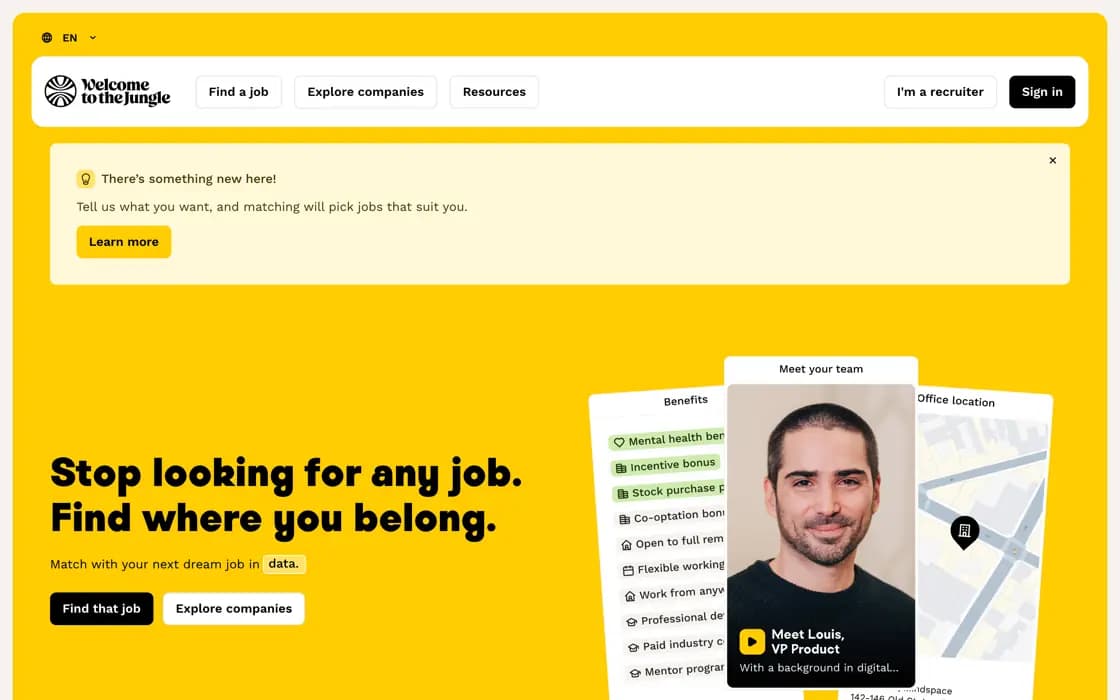
A European-rooted careers platform with strong company profiles and video, which absorbed Otta in 2025.
Best for
Reading about a company's culture in more depth than a careers page allows. It placed sixth of nine on response rate, ahead of Indeed and LinkedIn.
Watch out
Otta's preference-driven matching, which was its main draw, has been diluted by the merge. Coverage is stronger in Europe than the US.
Evidence
Confirmed firsthand: otta.com now redirects to uk.welcometothejungle.com.
80,000 Hours job board
- free, including the advising
- mission-driven
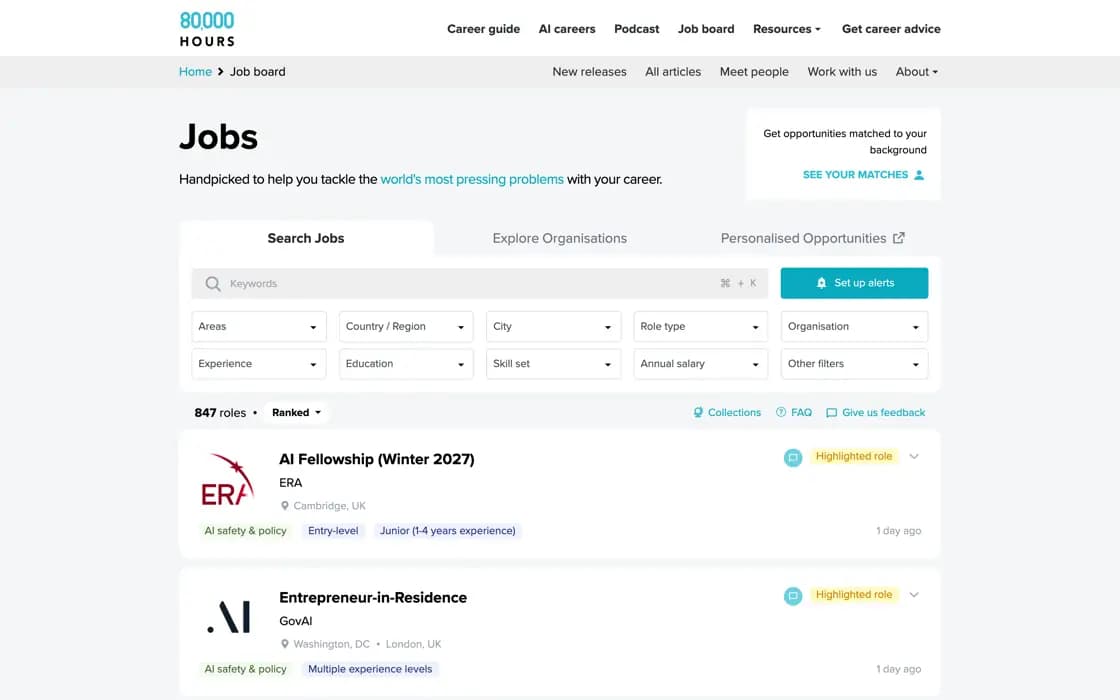
A hand-screened board of roles the organization judges high-impact, spanning AI safety, biosecurity, policy and global health.
Best for
People optimizing for impact over compensation. The screening is real and the free one-to-one advising is unusual.
Watch out
A specific worldview shapes what gets listed. Small volume and highly competitive.
Climatebase
- board free, fellowship paid
- sector board
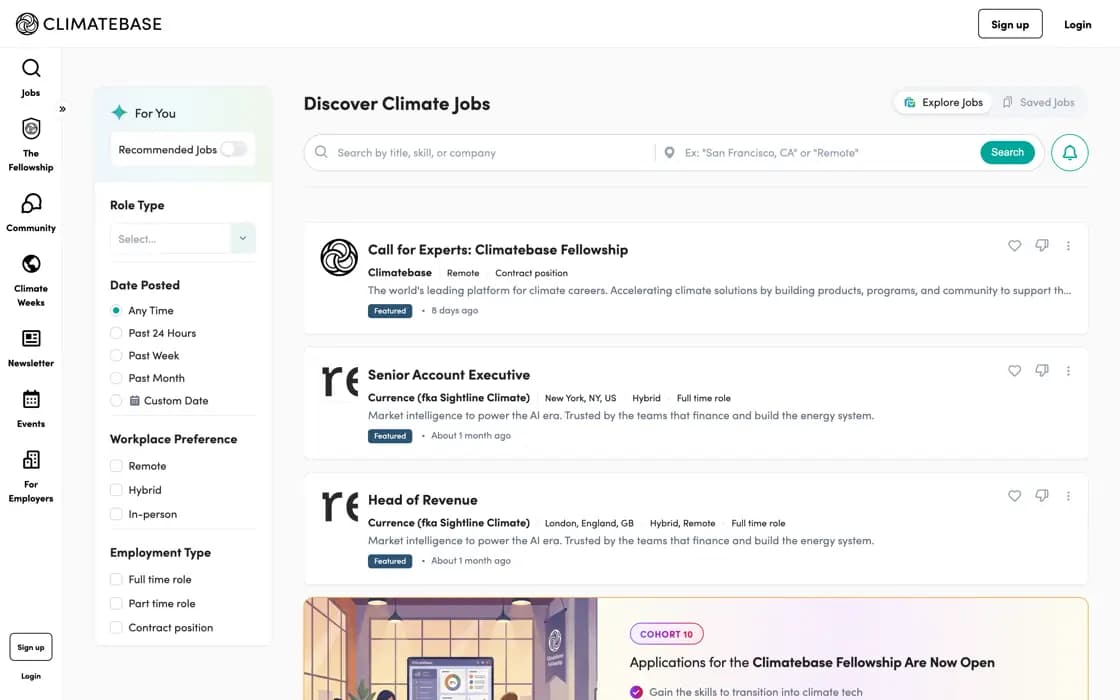
The main job board for climate and clean-energy work across technical and non-technical roles.
Best for
Moving into climate from another sector, which is the transition it is actually built around.
Watch out
The sector's funding is cyclical, and the paid fellowship is a separate product from the free board.
Arc.dev
- free for candidates
- vetted marketplace
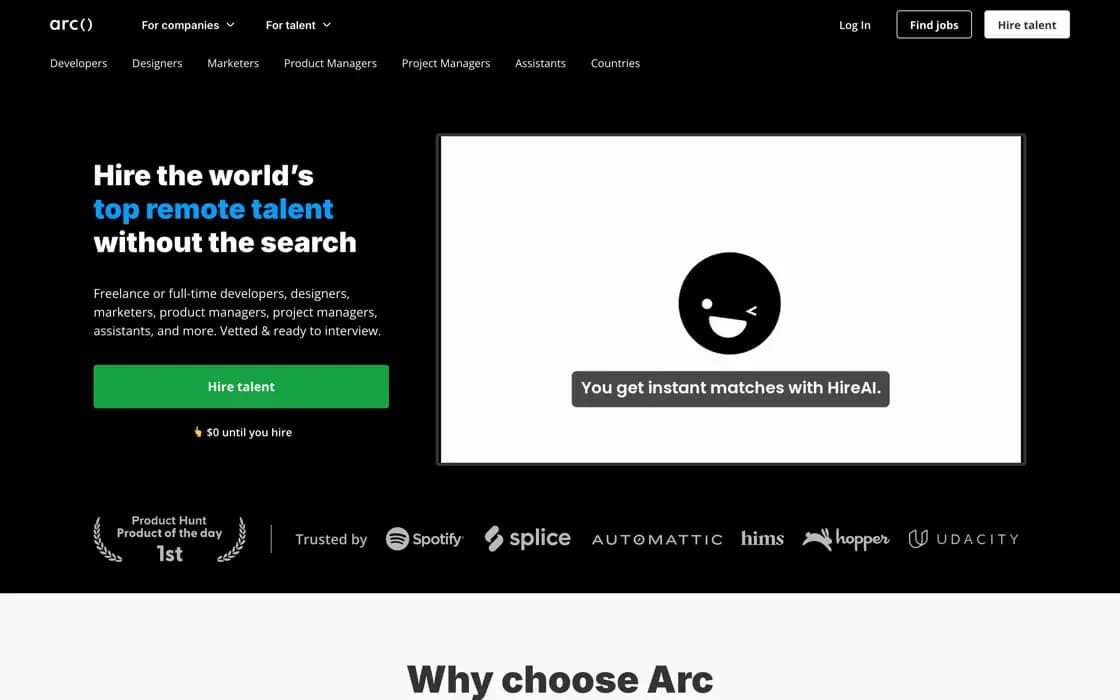
A vetted marketplace for remote developers, covering both full-time roles and contract work.
Best for
Remote contract work if you clear the screening.
Watch out
Read the numbers before you invest the hours. Its own marketing cites roughly 450,000 candidates against 800-plus hires, which is under 0.2 percent. The screening cost falls on you, and the odds it quotes are its own.
4 Day Week
- free
- niche filter
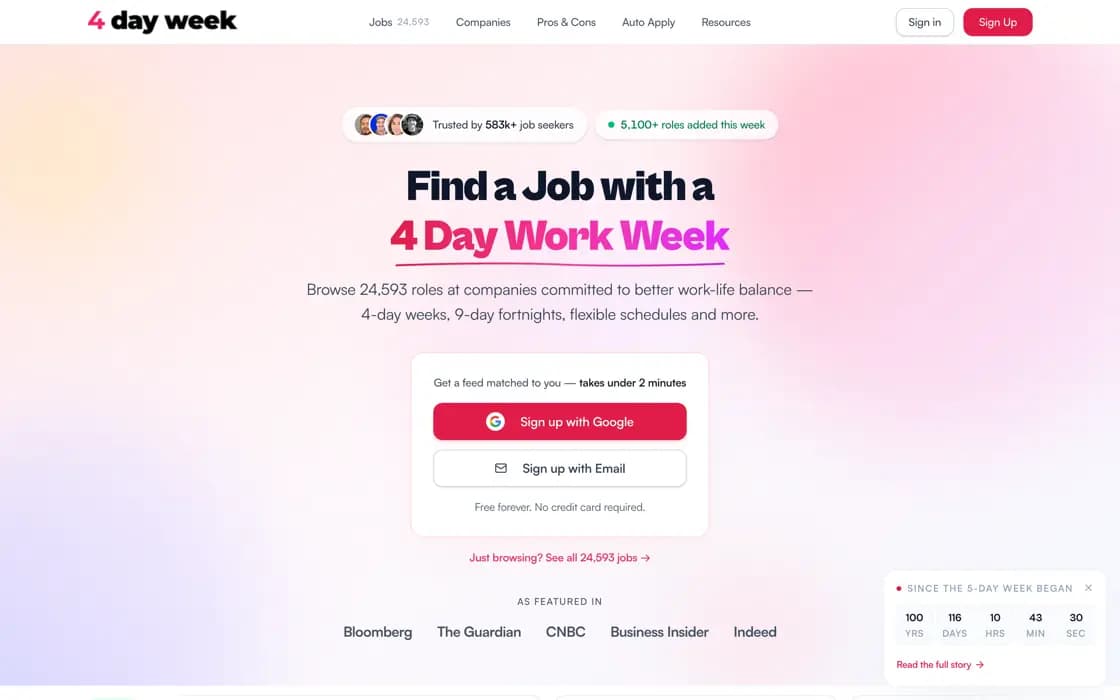
A board listing only roles at companies with a four-day week or a 32-hour schedule.
Best for
One specific, verifiable filter that no generalist board can express.
Watch out
Small and self-reported by employers. Confirm the schedule in the interview rather than trusting the tag.
Tech Ladies
- freemium
- community board

A job board and community for women in technology, where employers pay to reach the membership.
Best for
Supplementing a search with employers who pay to recruit women in tech, which is a weak but real signal about how they staff teams.
Watch out
Volume is modest and the best features sit behind membership. Treat it as a supplement, not a primary search.
The skip list
Boards to skip, and why
This is the more useful half of any list like this, and the half that usually gets left out. Everything below was checked in 2026. Several of these still appear, in the present tense, on lists published this year.
Actively bad value
Real sites, actively working against you: paywalled basics, manufactured urgency, or a yield their own marketing admits is poor.
The clearest quality collapse in the set, and still on nearly every remote list. On the day we checked, its front page carried, tagged worldwide, a sandwich shop role, a hotel bell captain in Macau, a building cleaner, parcel delivery drivers in India and a retail associate in Chicago. Its public API returned 99 listings and exactly one carried a salary, on a board whose own tagline is open salaries. Salary is now a premium feature at 14.95 dollars a month on a stated twelve-month commitment.[4]
It tells you outright that you are seeing a fraction of available roles, runs a countdown timer next to a discount banner, and publishes no price anywhere until you have handed over an email and completed onboarding. A countdown clock on a job board aimed at people who are out of work is the whole argument against it.[5]
A curated board that has stopped curating. Its paid featured slots were occupied by a proprietary-capital forex and crypto offer and by commission-only sales roles, which is exactly what a curation promise exists to filter out. It also publishes its own scam-warning page, so the problem is known internally.[6]
The only pay-before-you-look board here. The structural complaint is that flexible quietly includes hybrid and location-bound roles, so you buy the index before finding out what is in it. We could not load the site across four attempts, so we can verify neither its counts nor its prices, and every FlexJobs figure in circulation should be treated as unverified.[7]
A paid subscription whose price is not publicly readable and whose reported tiers contradict each other across sources, including an annual price below a single quarterly one. You would be paying for filtering over listings that are individually free elsewhere.[8]
Massive's own FAQ states employers cannot detect that an application came through it, and its own marketing puts the yield at one to two interviews per hundred applications. LazyApply sells a tier at 999 dollars a year for up to 1,500 applications a day. Meanwhile Greenhouse's chief executive named this category on the record as the cause of the volume problem, and both Greenhouse and LinkedIn have shipped identity verification and volume filtering in response. You would be paying to be ignored more efficiently.[9]
Not a portal, and the product is the risk. Its function is feeding answers to a candidate during a live interview. Employers moved hard against this class of tool through 2025 and 2026, including reintroducing in-person rounds. The downside is a rescinded offer and a reputation, not a refunded subscription.[10]
Every headline figure is self-reported on its own landing page: two million users, eight million jobs, three times the interviews. It publishes no price for job seekers at all, and jobright.ai/pricing returned a 404 when we checked, while third-party reviews cluster around 39.99 dollars a month.[11]
A large SEO-driven aggregator with pass-through to third parties and no meaningful product for job seekers. Its geo-redirect is also visibly broken: the canonical address sent us to a country subdomain that does not resolve in DNS, which tells you how much attention the front door gets.[12]
Indeed's index under a different logo, and Indeed-owned since 2016. Searching it after searching Indeed is the same search twice, with none of Indeed's product investment.[13]
Dead, and still on other people's lists
Every one of these still appears in the present tense in articles published this year. Every one failed when we opened it.
Dead, and the single fastest test of whether a list was actually checked. hired.com redirects to an LHH corporate page that does not contain the word Hired in its visible text. It is still recommended in the present tense by articles published this year.[14]
Both dead, both still cited. Stack Overflow discontinued its jobs product in 2022 and stackoverflow.co/jobs returns a 404 today. Triplebyte wound down and Karat acquired its assessment technology, not its talent network. The loss is real: nothing in 2026 replaces pass one screen, apply everywhere. We checked the obvious candidates, and interviewing.io, Braintrust and A.Team have all repositioned to selling to employers or to AI data work.[15]
Announced its closure in 2024 citing loss of funding, ending all programs including the job board, at a peak of more than 340,000 members. It still appears in current best-of lists more than two years later, which is the clearest illustration available of how this genre decays.[16]
Dead, and quietly so. The domain no longer serves its own site and redirects to a free static-hosting placeholder describing a period of transition. A company that has parked its domain is not a board to plan a week around.[17]
Both were sold in bankruptcy proceedings in 2025 and both still load, which is precisely why they keep reappearing on lists. Neither carries meaningful inventory for this reader. We will not assert who owns CareerBuilder now: the widely reported buyer and the name in its own site footer do not match, and we could not resolve it against a filing.[18]
Real, just not for this reader
Nothing wrong with these. They serve a different person than the one this page is written for.
Not bad, just not for this reader. It placed fifth of nine on response rate, which is genuinely good, but its inventory is built around university students and recent graduates. If you are early career it belongs in your top three. Mid-to-senior, it is noise.[1]
Skippable for mid-to-senior technology roles. The employer base is small-business and staffing-weighted, and it placed last of the nine sources measured on the same population, at 2.82 percent.[1]
Both appear in 2026 hot-AI-platform lists and neither is a job portal. Both sell AI training data and model evaluation work. They are real options if you want contract AI-evaluation work and useless if you want a permanent role.[19]
The other half
The portal gets you seen. The resume decides whether you get read.
Almost every portal above ends in the same place: a form, and a document a stranger will spend a few seconds deciding about. Hacker News and Work at a Startup are the exceptions, which is part of why they are on the list. Everywhere else, at 254 applicants for an average posting, being a reasonable candidate is not the bar. Being an obviously relevant one, quickly, is.[3]
It is worse than the raw count suggests, because some of that pile is not real. Greenhouse classified 18 to 22 percent of jobs posted on its platform in a given quarter as ghost jobs, advertised with no intent to hire. That figure is from 2024 and has not been refreshed, so treat it as directional. The practical effect is that your effort is spread across postings, a fifth of which may never hire anyone.[20]
The obvious response, applying to far more jobs, is the one that stopped working. The auto-apply vendors' own numbers are in the skip list below, and they are not good. Meanwhile the employer side spent two years building defenses against exactly that traffic, including identity verification. Volume is now the strategy everyone else is running, and it is the one employers are actively filtering for.[21]
Which leaves the unglamorous answer. Fewer applications, each one written for the posting actually in front of you, using what you have genuinely done. That is slower per application and it is the only part of this process still fully under your control.
Specific Resume is a job-description-specific resume builder. It is not in the rankings above, because ranking ourselves on our own page would make the rest of it worth less. If the argument here landed, the part we work on is the last step: the document that has to survive the scan.
What changed
What changed in 2026
If you only wanted the list, you already have it. This is the context behind it, for anyone who wants to know why the market looks like this. Every claim traces to a source we opened, and where we could not verify something we say so.
The boards earn more per posting in a shrinking market
Recruit Holdings, which owns Indeed, Glassdoor and SimplyHired, reported 1.64 billion dollars in US HR Technology revenue in its most recent reported quarter, up 30 percent year over year, with average revenue per job up 35 percent, in a period when US job postings fell roughly 4 percent. More money earned per posting, in a market with fewer postings. We will not tell you exactly what that buys, because the segment covers more than job advertising and the lines cannot be separated from outside, and paid placement on job boards is decades old rather than new. One concrete change did land: from 2026 Indeed stopped giving free organic visibility to jobs delivered through single-source XML feeds unless sponsored. Employers on ATS integrations keep it and Indeed still scrapes public career pages, so this is one route closing rather than the end of free posting.[22][23]
Three of the big generalists became one company
Recruit Holdings owns Indeed, Glassdoor and SimplyHired, and cut 1,300 roles across Indeed and Glassdoor in 2025 in a consolidation its chief executive framed around AI. The Glassdoor integration completed in 2026. Microsoft owns LinkedIn. Monster and CareerBuilder were both sold out of Chapter 11 in 2025. The practical consequence is the one in the opening: searching Indeed, then Glassdoor, then SimplyHired is largely one index seen three times.[24][2][25]
Applying became free, so being read became the scarce thing
Greenhouse chief executive Daniel Chait told Fortune in 2026 that the platform carries 175,000 live jobs at an average of 254 applicants per posting, and named cheap mass-apply tools as the mechanism behind what he calls an AI doom loop. One caveat we will not bury: Fortune states no time window for the 254, and an applicant count without a period is not a rate. What that volume actually returns is in the skip list below, in the auto-apply vendors' own numbers.[3]
Ghost jobs have a defensible number, and it is getting old
Greenhouse's State of Job Hunting report, published 2024, classifies 18 to 22 percent of jobs posted on its own platform in a given quarter as ghost jobs, defined as positions advertised with no intent to hire. The same report found 61 percent of job seekers had been ghosted after an interview, up nine points in eight months. Two honest caveats. That measurement is from 2024 and has not been refreshed in twenty months, so we date it every time we use it. And the widely repeated claim that one in three listings is fake comes from surveys asking HR professionals what they do, not from counting listings, which is a different claim.[20][26]
Regulation is close but has not landed
New York's S8877 would require employers with at least 100 staff, and third-party job posting sites, to disclose whether a posting reflects an active vacancy and when they expect to fill it, with a 2,500 dollar penalty per non-compliant advertisement that doubles every 30 days it stays uncorrected. It passed both chambers in 2026 and is awaiting the Governor's signature. Passed and law are different sentences. As of 2026 no US state has a ghost-job disclosure requirement in force.[27][28]
AI split the tooling in two, and only one half helps you
Tools that help you decide where to apply got better and mostly stayed free: structured filtering at HiringCafe, profile matching at Himalayas, level mapping at Levels.fyi. Tools that apply on your behalf got more expensive and more counterproductive, because the employer side spent two years building defenses against exactly their output. Greenhouse shipped Verified badges in 2024 and an identity-verification partnership with CLEAR in 2025, citing a Gartner forecast that up to 25 percent of applicants could be fraudulent by 2028. A quieter 2026 development matters more: boards began exposing their index to AI assistants directly. Dice shipped a public MCP server in 2026 and Himalayas runs one whose search tools need no authentication. The research half of a job search is becoming agent-driven while the application half still needs a document written for one posting.[29][30][21]
Sources
Numbered in the order they appear above. URLs are printed rather than linked, so nothing here sends you off the page by accident. Entries without a URL are things we checked ourselves on the date given.
Boston University Feld Center / Huntr, 598,627-application job search dataset, published 2026
https://questromfeld.bu.edu/blog/2026/03/10/announcing-the-9-best-job-search-sites-job-boards-of-2026-backed-by-600k-applications/Reworked, "Glassdoor folds into Indeed"
https://www.reworked.co/employee-experience/glassdoor-folds-into-indeed/Fortune, Greenhouse CEO Daniel Chait on the AI doom loop, 2026
https://fortune.com/2026/07/27/greenhouse-ceo-daniel-chait-ai-doom-loop-job-seekers-spam-interview-applications-unemployment/remoteok.com, its API and its premium page, all checked in 2026
remotive.com, checked in 2026
jobspresso.co, checked in 2026
repeated fetches of flexjobs.com timed out when we tried in 2026
pricing page not publicly readable; reported prices differ across every secondary source found
vendor sites checked in 2026; Fortune, 2026
finalroundai.com, checked in 2026
jobright.ai checked in 2026; /pricing returns HTTP 404
www.talent.com, checked in 2026
Recruit Holdings ownership; site served an automated-traffic challenge in 2026
redirect verified firsthand in 2026
stackoverflow.co/jobs returns HTTP 404, verified 2026
closure announcement, 2024
redirect verified 2026
careerbuilder.com and monster.com footers, checked in 2026
micro1.ai and mercor.com homepages, 2026
Greenhouse, State of Job Hunting report, published 2024
https://www.greenhouse.com/blog/greenhouse-2024-state-of-job-hunting-reportGreenhouse newsroom, Greenhouse and CLEAR candidate-verification partnership, 2025
https://www.greenhouse.com/newsroom/greenhouse-and-clear-announce-partnership-to-enable-candidate-verificationRecruit Holdings Q1 FY2026 earnings call transcript, most recent reported quarter
https://www.investing.com/news/transcripts/earnings-call-transcript-recruit-holdings-lifts-fy-2026-outlook-after-strong-q1-93CH-4845376HR Dive, "Visibility ends for certain free single-source XML feeds on Indeed"
https://www.hrdive.com/news/visibility-ends-for-certain-free-single-source-xml-feeds-on-indeed/816209/TechCrunch, "Indeed, Glassdoor to lay off 1,300 staff amid AI push", 2025
https://techcrunch.com/2025/07/11/indeed-glassdoor-to-lay-off-1300-staff/Job Board Doctor, "Indeed and Glassdoor turn the screws as multiple deadlines loom", 2026
https://www.jobboarddoctor.com/2026/03/13/indeed-and-glassdoor-turn-the-screws-as-multiple-deadlines-loom/Hunter Ng, "Ghost Jobs", arXiv preprint 2410.21771, 2024
https://arxiv.org/abs/2410.21771New York State Senate, Bill S8877 (2025-2026 session)
https://www.nysenate.gov/legislation/bills/2025/S8877Thompson Coburn, "NY legislature passes bill targeting ghost jobs"
https://www.thompsoncoburn.com/insights/ny-legislature-passes-bill-targeting-ghost-jobs/Dice, "Dice launches MCP server for AI-powered job search", 2026
https://www.dice.com/career-advice/dice-launches-mcp-server-for-ai-powered-job-searchHimalayas, public MCP server documentation
https://himalayas.app/mcpMethod
How this was researched. Six parallel research passes over the 2026 landscape, covering the generalist aggregators, tech-specialist boards, remote-first boards, AI-native entrants, grassroots signal, and adjacent surfaces such as applicant tracking systems and portfolio boards. That produced 111 candidate entries, deduplicated to 87 distinct portals.
Every candidate then went through adversarial verification whose default posture was that each claim was wrong until a fetched page proved otherwise. Of the 87, 31 are recommended above, 18 are named in the skip list, and the rest were dropped without comment as too small, too niche or too thinly evidenced to be worth your time either way.
Screenshots are of each site's own homepage or job index, captured in 2026 at 1440 by 900. Consent scripts were blocked at the network layer and consent banners were hidden rather than accepted or declined, so no consent was given on anyone's behalf. Sites serving an automated-traffic challenge were left uncaptured rather than worked around, except Indeed, which was captured by hand in a signed-in browser. Captures ran from a European address, so HiringCafe and Levels.fyi show a non-US view; both are labeled on the card.
Where we could not verify something, it is either absent or labeled unverified.