Product Manager Resume Examples
Create your perfect Product Manager resume
Tailor a job-specific resume and cover letter for every application.
Sample resumes
One resume per career level, each written with Specific Resume and tailored to one job posting. The people are fictional, and the employers are real companies used as examples.
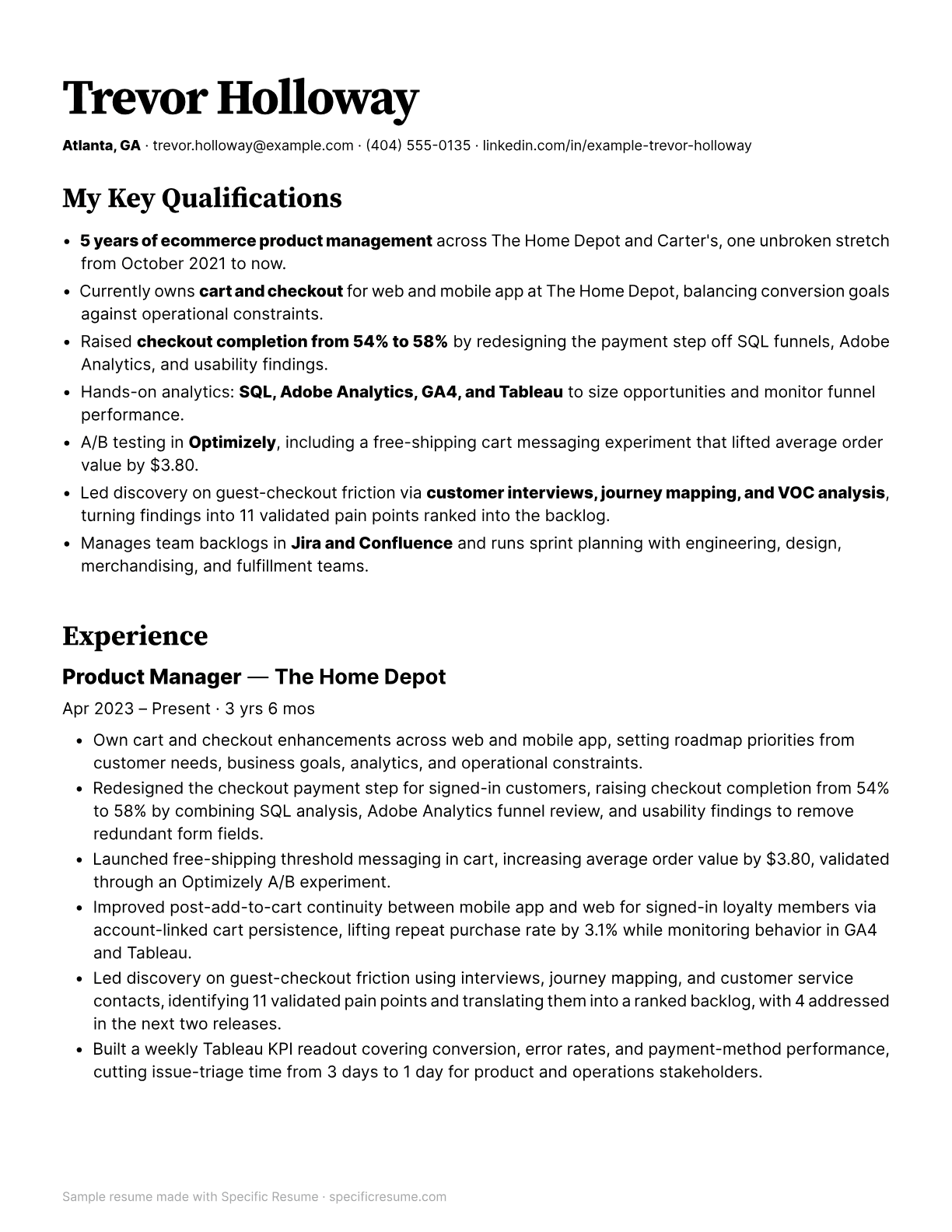
Page 1 of 2
Here are three Product Manager resumes, entry, mid and senior level, each tailored to one job posting. Tailoring doesn't mean inventing anything. It means choosing the results from your real experience that answer what the posting asks for, and describing them in the posting's own words, so a recruiter sees the match in the first few lines. Open any of them above, or download it as a PDF. The people are invented.
This isn't the classic resume layout, and we didn't pick it on taste. In our blind test with 20 recruiters, they screened a stack of resumes without knowing which one was ours. With the same qualifications, this layout was shortlisted in 12 of 13 sessions, against 3 for a two-column template.
How crowded openings are
- 291 applications per hire across over 109M applications and 247K jobs, January 2021 to March 2026. (Ashby, Recruiter Productivity | 2026 Talent Trends Report, April 2026.)
- 244 applications per job across over 6,000 companies and over 640M applications, 2022 to 2025. (Greenhouse, The Hire Standard, March 2026.)
Both figures cover every kind of role, not product managers alone.
Why these resumes are built this way
At that volume, a recruiter decides in seconds whether to read on, and what they look for is the job description. In our blind test, six candidates met every requirement of a marketing manager opening, and what decided their order was how fast a recruiter could find it. Every choice below comes from watching recruiters screen resumes, and why this format works sums it up on one page.
- Tailored to one posting, never invented. Each resume answers one job description. The experience stays the same; what changes is which results come first and the words used for them. When we asked the recruiters in our blind test about tailoring, they said a resume in the posting's words is faster to check, and that the first phone call is where they test whether you can back it up.
- Key Qualifications first. Up to about seven lines at the top restate what the posting asks for, each answered with something the person did. Recruiters in our blind test ticked these off one by one before they read the work history.
- The posting's words, in bold. When the posting asks for "Use SQL, Adobe Analytics, GA4, Tableau, and Optimizely to monitor performance, size opportunities, and evaluate experiments.", the resume says SQL, Adobe Analytics, GA4, and Tableau. A recruiter scanning for a requirement finds it without reading the sentence. Bold also marks the result that proves it.
- A title recruiters recognize. In our interviews with 43 recruiters, they described hiring software that first shows a list of applicants with each one's latest title, company and location, and they open only the applicants whose title looks like a match. A niche internal title is worth translating into the one the market uses.
- Every employer explained. Recruiters in our blind test searched online for any employer they didn't recognize. So a lesser-known company gets a short line after its name saying what it does ("software marketplace and review platform for business technology buyers"). A household name needs none.
- Years in plain sight. Each job shows how long it lasted, so nobody has to count dates. Recruiters in our test stopped to do exactly that when it was missing.
- Numbers with a baseline. A line like "improving completion rate from 61% to 68%" gets believed. A bare percentage gets discounted.
- Detail where recruiters read. Recruiters read the latest job closely and skim the rest, so it gets the most bullets, and older jobs shrink to a few lines. One column, newest first, nothing in a sidebar.
- Written for a person. In our interviews about how recruiters screen applications, the automatic rejections they described came from questions on the application form, and none described an AI rejecting a resume. A person reads what you send.
These nine points are the short version of what we found. The blind test shows the six resumes recruiters compared, what they said about each one and a full checklist. Our interviews with 43 recruiters show how they get through hundreds of applications for one job, and how long a resume gets before they decide.
Entry-level Product Manager resume
Associate product manager, 1 year of experience, tailored to an associate product manager posting at a fintech startup. What to get right at this level:
- State your experience plainly. Put the short stint in the first screenable lines, like "One year as an Associate Product Manager", so nobody has to infer it from dates.
- Write real bullets, not tasks. Even with limited tenure, one strong metric line such as "lifting account-setup completion from 61% to 68%" reads like product work, not coursework. An internship, a class project or a part-time job counts, written the same way.
- Use projects to prove fit. This resume uses a capstone and a campus project to show relevant skills, including "participants completing setup 19% faster". One or two projects that answer the posting can show competence that a short work history cannot.
Mid-level Product Manager resume
Product manager, 5 years of experience, tailored to a product manager posting at an omnichannel retailer. What to get right at this level:
- Lead with what you own. Mid-level PMs should name a surface area they are accountable for, like "Currently owns cart and checkout", not just what they supported.
- Let the latest job carry weight. This resume is 6 bullets as Product Manager and 4 as Associate Product Manager, which matches how recruiters actually allocate attention to recent work.
- Retire the student years. Education is already one line with a degree and school. That is enough once you have multiple years of shipped work.
Senior Product Manager resume
Senior product manager, 8 years of experience, tailored to a senior product manager posting at a cloud healthcare software company. What to get right at this level:
- Show scope and who you leveled up. Senior resumes should include cross-team standards and people impact, like "Mentors PMs and Associate PMs" paired with a visible operating change such as "raising readout coverage from 5 tests per quarter to 13".
- Compress the past. This resume uses 6 bullets as Senior Product Manager, 4 as Product Manager, and 3 as Associate Product Manager. Earlier roles should keep shrinking to a line or two or come off, because recruiters in our blind test said a long work history can make a candidate look older, and some admitted that can bias them.
- Keep length to what experience needs. At senior level, one page can look thin. Past two pages recruiters lose patience, so keep only the roles and bullets that still support the target scope.
Make one for your own posting
- Start from the posting, not your old resume. List its requirements.
- Answer each one in your Key Qualifications with something you actually did, in the posting's words, with the key terms in bold.
- Give every result a number and a starting point.
- Use the posting's words, never its whole sentences: recruiters in our test called copied sentences a red flag. The checklist from our blind test covers the rest.
Sources
Our research:
- Best resume format: a blind test with 20 recruiters
- How recruiters actually screen when hundreds apply to one job
- Why this format works
Other data:
- Ashby, Recruiter Productivity | 2026 Talent Trends Report, April 2026
- Greenhouse, The Hire Standard, March 2026